BIM Services - Uniquescadd

Role of BIM in Improving Collaboration Across the AECO Industry

The architecture and construction industry has witnessed a transformative growth over the years. A long list of changes has altered the working approach for architects, engineers, and other professionals. Efficiency, accuracy, reliability, and safety have always been key factors in the success of any construction project. Not just this, but ensuring the intricate design and functionality of the building that makes it a livable and comfortable environment for occupants.

Earlier, architecture featured intricate designs executed with traditional methods, including hand-drawn sketches, traditional tools, and manual processes. All these were prone to errors and were significantly time-consuming. While innovations and technologies altered the way architects, engineers, designers, and others work, the AEC industry entered a new level of transformation.

Earlier, the AEC sector was known as architecture, engineering, and construction. However, as the industry rapidly evolved, “O” stands for operations. Today, the significant sector of the economy is popularly known as AECO- architecture, engineering, construction, and operations. A digital revolution that changed the face of industry was also backed by building information modeling technology. BIM replaced traditional, manual methods and offered a long list of benefits, resolving many challenges faced by experts.

In light of that, BIM has reshaped how projects are planned, designed, executed, and maintained. With the digital revolution, AEC is now transformed to AECO- operations that have also simplified the complex and time-consuming process. As a matter of fact, BIM modeling services play a crucial role in the AECO realm, enabling them to enhance complex projects, minimize errors, improve collaboration, and more. Moreover, the continuous technological growth in the AECO realm alters the working approach for AEC experts, thanks to BIM services that offer a plethora of advantages, including improved project execution, enhanced project lifecycle, and more.

BIM for architects, engineers, contractors, and other professionals cannot imagine a project without BIM implementation in the digital landscape. Although this implementation may seem simple, it involves a variety of challenges, especially in the AECO. To briefly understand the significant role of building information modeling in AECO, let’s break down the industry individually and understand how BIM plays a pivotal role.

Streamline Complex project with BIM modeling Services

bim services

Breaking Down AECO Realm

The construction sector has been a key contributor to the overall economy, enabling the nation’s growth with well-built infrastructure and designs. Traditionally, construction was a manual process, from hand-drawn sketches to intensive labour to gather all the materials and more. The manual process in architecture and construction poses various challenges that lead to errors, slow processes, labour-intensive work, significant material waste, project delays, and more. Therefore, to overcome the consecutive challenges in the realm, the digital revolution transformed.

Turning the construction sector into AECO, that is, the architecture, engineering, construction, and operation realm. This digital revolution encompasses the entire project lifecycle, from planning, designing, and executing the site. It involves key sets of AEC professionals, including architects, engineers, contractors, facility managers, and more. Not just this, the modern landscape of AECO heavily relies on digital tools like BIM modeling services that bring enhanced efficiency, precision, and safety, contributing to project success. To better understand this, let’s break down AECO.

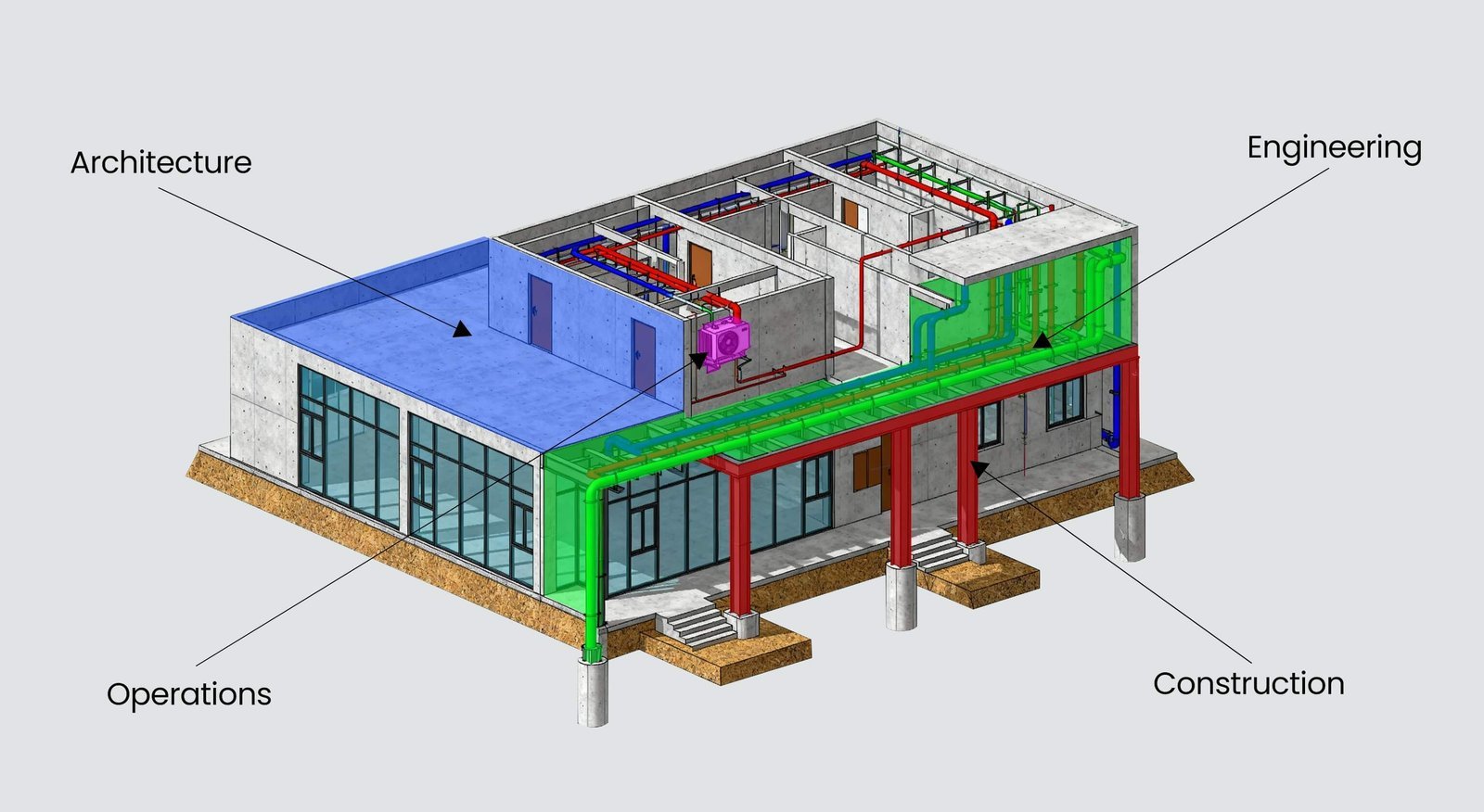
Architecture: This involves the initial design and planning phase, where architects and other professionals create a plan and blueprint for the project’s layout at an early stage. The project’s layout provides a clearer understanding of the concrete processes. The architecture stage involves planning and designing how the project will proceed further.

Engineering: In this stage, a technical design phase is conducted that includes structural BIM services, MEP BIM services, and architecture to ensure a digital representation of the plan, typically in a 3D view. Engineering is a field where various types of engineers collaborate to maintain precision.

Construction: This is a specific stage where the onsite process begins. Here, the digitally built model and plans play a crucial role. Contractors and other AEC professionals construct infrastructure in accordance with design plans and specifications, minimizing errors and ensuring precision in groundwork.

Operations: AEC is a vast and evolving sector where “O” operations have recently been added. This phase particularly entails ongoing use and maintenance of the project, including facility management, repairs, system upgrades, and more.

This breakdown of AECO gives a sense of how professionals are segmented by phase. Collaboratively, it enables professionals to work together digitally and offers precision without any scope for errors. As a matter of fact, the AECO industry leverages key technologies, such as BIM modeling services, to enable each expert to enhance project processes, workflows, and overall results.

However, the construction process involves several significant stages that are vital to completing any construction project. The following is the workflow that is evident. The process can be broken down into the following key stages, with each involving specific tasks and collaboration among different stakeholders:

Stages of BIM Integration in Construction Process

Conceptual Design & Planning
Preconstruction & Bid Management
Detailed Design & Documentation
Construction & Field Management
Operations & Maintenance
  • Conceptual Design & Planning: This initial phase involves creating initial sketches, ideas, and detailed plans based on client requirements. Architects and engineers perform site analyses to inform design choices, often using generative design and AI tools to explore alternatives and optimize for sustainability and performance.
  • Detailed Design & Documentation: The design is refined, materials are selected, and engineering systems (structural, mechanical, electrical, plumbing) are incorporated. This stage results in detailed 3D models and 2D construction documents, including drawings and specifications. BIM plays a central role here, centralizing information for all agents.
  • Preconstruction & Bid Management: Project data is used to plan construction logistics, estimate costs, and manage the bidding process. AI-powered tools help identify potential risks, generate submittal logs from specifications, and perform quantity takeoffs, ensuring accuracy and efficiency before physical work begins.
  • Construction & Field Management: The physical asset is built according to the construction documents. This phase involves project management, scheduling, quality control, and safety management. Onsite teams use software to access real-time project data, track progress, manage issues, and document site conditions with photos and reports.
  • Operations & Maintenance: After construction, the building or infrastructure is managed and maintained throughout its lifecycle. This stage often uses digital twins (dynamic, virtual representations of real-world systems with real-time sensor data) to predict maintenance needs, optimize energy use, and monitor overall performance, resulting in significant cost savings and improved sustainability.

Nonetheless, BIM offers a variety of advantages, and its role has become prominent as AEC professionals cannot proceed without a 3D data-rich mode. Let’s shed some light on the benefits of BIM in AECO.

Significance for AECO Industry BIM Adoption

Traditionally, the AECO industry has faced multiple challenges across various aspects of construction projects. Intricate design, on-time project delivery, seamless processes, efficiency and precision, budget constraints, and more were challenges initially faced with traditional practices. However, with the evolution in technology and the introduction of 3D BIM, the game has leveled up, offering valuable insights, seamless communication and collaboration, visualization, and more.

AECO professionals can easily collaborate, ensuring that every phase of construction is executed seamlessly. Moreover, BIM is the whole truth, serving as a common platform that allows professionals to collaborate and communicate efficiently. From the level of detailing to seamless integration of structural, architectural, and MEP design, 3D BIM is a powerful tool for the industry.

In simple words, BIM for architects, engineers, contractors, and other stakeholders is a non-negotiable concept that provides insights to help make informed decisions. Building information modeling is a digital representation of a project’s physical and functional characteristics that enables experts to ensure precision, efficiency, safety, and more.

As a matter of fact, the AECO industry’s BIM adoption has transformed how projects are planned, designed, and executed, from facilitating better decision-making to minimizing waste and ensuring a more sustainable project lifecycle. BIM isn’t just a tool but a vast concept that helps architects, engineers, and other professionals streamline complex processes and foster efficient collaboration. As a matter of fact, the AEC industry demands effective communication and collaboration that result in project success. Nonetheless, BIM coordination workflow and seamless functional approach bring a variety of benefits, as follows;

Key Advantages of BIM coordination

Improved project visualization
Enhanced project maintenance
Cost and time savings
Efficient resource utilization
Communication and collaboration
Efficient planning and execution
Reduced rework
On-time project delivery
  • Improved project visualization: One of the major benefits of BIM modeling in the AECO industry is the 3D view it provides, enabling better visualization of construction, architectural, structural, MEP, and other aspects. This 3D view enables informed decision-making and better results, without errors or clashes with other components.
  • Communication and collaboration: Every construction project varies from each other in different aspects. However, a common thread across every project is communication and collaboration for optimized, accurate outcomes. BIM collaboration in AECO is a vital factor that allows experts to ensure precision. Miscommunication can lead to incorrect decisions among professionals and impact the project’s overall outcome.
  • Enhanced project maintenance: Constructing any infrastructure isn’t the end goal; however, its accurate maintenance makes the project successful. The project lifecycle of any building is a crucial aspect supported by BIM, offering key insights into infrastructure, precise construction documentation, efficient renovation understanding, and more.
  • Efficient planning and execution: With the help of BIM coordination workflow, AEC professionals can seamlessly design, plan, and execute the project with a 3D view. This enables detailed information, a curve of creativity for designers, easy design changes when required, and accurate integration across all disciplines.
  • Cost and time savings: Building information modeling is a time-saving and cost-efficient tool in the AEC industry. Sticking to a project budget is a key factor for project success. Moreover, with BIM implementation, experts can save significant rework costs, minimize waste material, ensure accurate resource allocation, and more. This allows them to stay within the project budget and reduce material waste.
  • Reduced rework: With 3D visualization and an intelligent, data-rich model, the scope of errors, clashes, and conflicts is reduced. This allows professionals to view the model, understand it, and make changes accordingly without adjusting the components of the infrastructure. Moreover, a 3D view also reduces errors on site, enabling less rework in the design stage.
  • Efficient resource utilization: In any construction project, a variety of materials are used, many experts are on the ground, and other aspects are also considered. With the help of BIM modeling services, AECO professionals can allocate resources more effectively and ensure efficient use without onsite waste.
  • On-time project delivery: Building information modeling is a key enabler of seamless efficiency, precision, and workflow. With accurate communication, collaboration, visualization, and the ability to minimize rework, on-time project delivery is ensured. This results in successful project completion and real-time updates with AECO professionals.

These are the key benefits of BIM in AECO; however, it continues to evolve as technology advances. As a matter of fact, BIM supports energy savings and material recycling, which are crucial to today’s modern demands. With endless benefits and result-oriented tools, it is evident that partnering with a renowned BIM outsourcing company is the right choice. Why ? Let’s find out.

Why Outsourcing BIM Services in AECO Landscape

The AEC landscape is vast, fast-growing, and constantly updating with various trends and technologies. In the modern architecture realm, many companies have yet to adopt BIM as a tool and face key workflow challenges. Although in the AECO industry, BIM adoption isn’t the endgame but the beginning of a streamlined approach for simple to complex projects. This adoption of new technology demands expertise, knowledge, and skills, as well as the ability to understand complex projects.

Moreover, BIM adoption is not only about a shift in technology and the adoption of new tools, but also about a significant change in processes, perspectives, and approaches for executing projects. Hence, outsourcing 3D BIM modeling is a comprehensive solution for AEC firms. Third-party service providers help with BIM modeling without the worry of investing in tools, hiring resources, or investing large amounts of capital.

A renowned BIM company ensures it delivers desired outcomes, efficient customer support, and accuracy and efficiency in BIM projects. UniquesCADD is a top BIM company offering a wide range of BIM services, from structural BIM services to architectural visualization. With a team of experienced professionals, uniquesCADD aims to provide accurate results within the desired timeline.

Final Words

BIM modeling services are powerful tools that have given the AECO industry a new face. It enables professionals to save time, improve accuracy, streamline processes, and enhance communication and collaboration. Therefore, from optimizing processes to maintaining the project lifecycle, BIM modeling is the comprehensive answer.

Top Scan to BIM Companies in 2026: Who’s Leading the Market

The AEC landscape has evolved rapidly with the rise in technology and constant innovation that streamlines the complex process. Constructing any infrastructure is a complex process demanding precision, efficiency, and reliability. Any project’s success depends on the accuracy of the construction and how well the building is maintained. The AEC industry is not only about constructing new infrastructures but also about renovating existing buildings to ensure safety, extend their lifecycle, maintain equipment condition, and more. Over the years, any construction building gets weak due to various reasons such as insufficient maintenance, environmental factors, and more. After a certain time, the structure of the building becomes weak, eventually requiring renovation to prevent any mishaps.

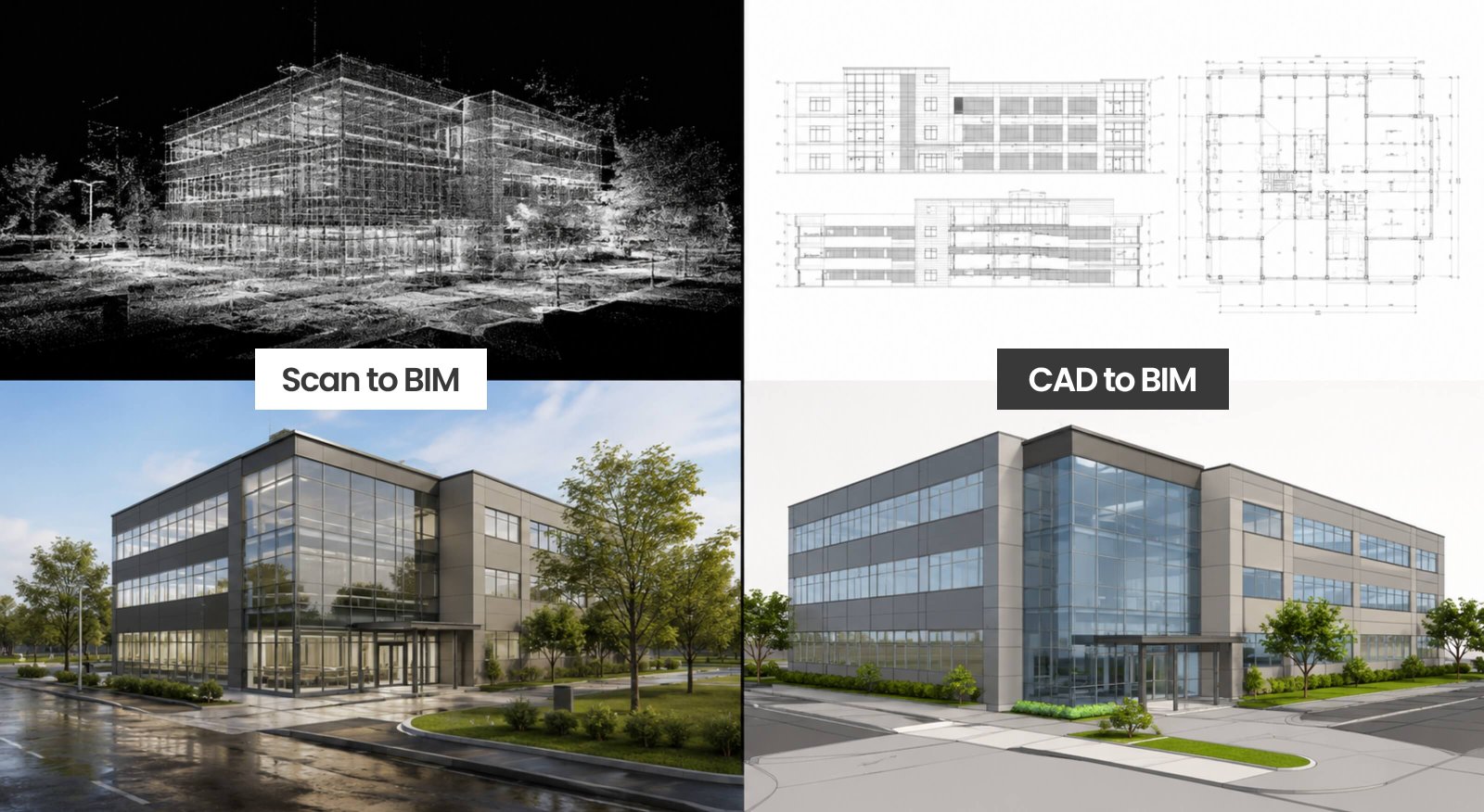
The architecture and construction landscape has potentially evolved with time and technology, leading to significant outcomes, improved precision in complex processes, and various benefits. As there is no introduction needed for building information modeling, it is also a beneficial technology for renovating buildings. Existing infrastructures are complex to renovate due to a lack of documentation, old drawings, missing details, manual measurements, and much more, leading to significant mistakes and delays. Hence, with evolving technology, scan to BIM, or popularly known as point cloud to BIM plays a crucial role in renovating the infrastructure.

As a matter of fact, the rising popularity of scan to BIM has transformed how construction firms and professionals renovate the infrastructure. The global market for scan to BIM services is projected to reach US$673 Million by 2031, CAGR 5.3%. This percentage showcases the increased usage of technology in the architecture and construction realm, enabling AEC firms to compete in the market as the best providers of scan to BIM services. Combining advanced techniques such as laser scanning with 3D BIM modeling allows professionals to view building insights for renovation, ensuring accuracy, safety, and adherence to construction standards. Any leading scan to BIM firms offers a wide range of services for residential, commercial, and infrastructure sectors.

Renovating any project has become easier and more profitable, thanks to advanced technologies, which have transformed the way architects and other experts design, build, renovate, and manage structures. This demands the right use of technologies and software, proficiency in processes, expertise in managing complex projects, and more. Hence, AEC firms in today’s rapidly evolving market tend to partner with scan to BIM company for efficiency and precision. Let’s explore key aspects of outsourcing scan to BIM. It is beneficial and leading scan to BIM firms partnering with the most suitable company.

Partner with UniquesCADD for Precise Scan to BIM Project

bim services

Major Aspects for Scan to BIM Outsourcing Companies

The demand for accurate scans to BIM or, per se, point cloud to BIM modeling services has exponentially grown. As a popular concept in the architecture and construction industry, it requires expertise in processes, proficiency in software, the ability to manage complex projects, and expert knowledge and guidance for successful renovation. As AEC firms are constantly occupied with a plethora of tasks and find novel ways to cut costs, outsourcing point cloud to BIM services is a comprehensive solution, enabling them to adopt a hands-on, accurate scan-to-BIM approach. Moreover, there is a growing demand for precision 3D models for surveying, designing, planning, renovating, and executing projects according to specific requirements.

Since historic or older buildings lack construction documentation, laser scanning or photogrammetry techniques allow the collection of data points that are further integrated into the BIM model. The integration process, being a crucial segment, demands accuracy and efficiency for the right BIM model.

Moreover, outsourcing firms offer a variety of aspects in the infrastructure, such as architectural, MEP, structural, and others. Outsourcing concepts have exponentially grown, thanks to a variety of benefits. However, identifying the appropriate and suitable scan to BIM outsourcing companies is evident for accurate results. The following are the key aspects to consider before partnering with a leading point cloud to BIM service provider.

Key Factors to Consider Scan to BIM Service Provider

Years of Experience
Resources
Technology and Software expertise
Effective solutions
Pricing Plans
Reviews and Client Testimonials
Range of Services
Project Delivery

These are some of the key factors that are essential to consider before partnering with scan to BIM company. The outsourcing market is vast, especially in the modern era, with various leading scan to BIM firms offering high-quality results and accuracy. Here’s a list of the top BIM companies in 2026 that are leading in the market for their exceptional services and client satisfaction ratio.

Top Scan to BIM Companies 2026

AEC firms tend to outsource BIM services, architectural services, structural services, MEP BIM services, interior visualization, and more for a new project. However, when it comes to renovating an existing infrastructure, scan-to-BIM services are the key players. The following are leading BIM firms in 2026, renowned for being experts in the process, delivering profitable outcomes, providing desired solutions, and being recognized in the AEC market.

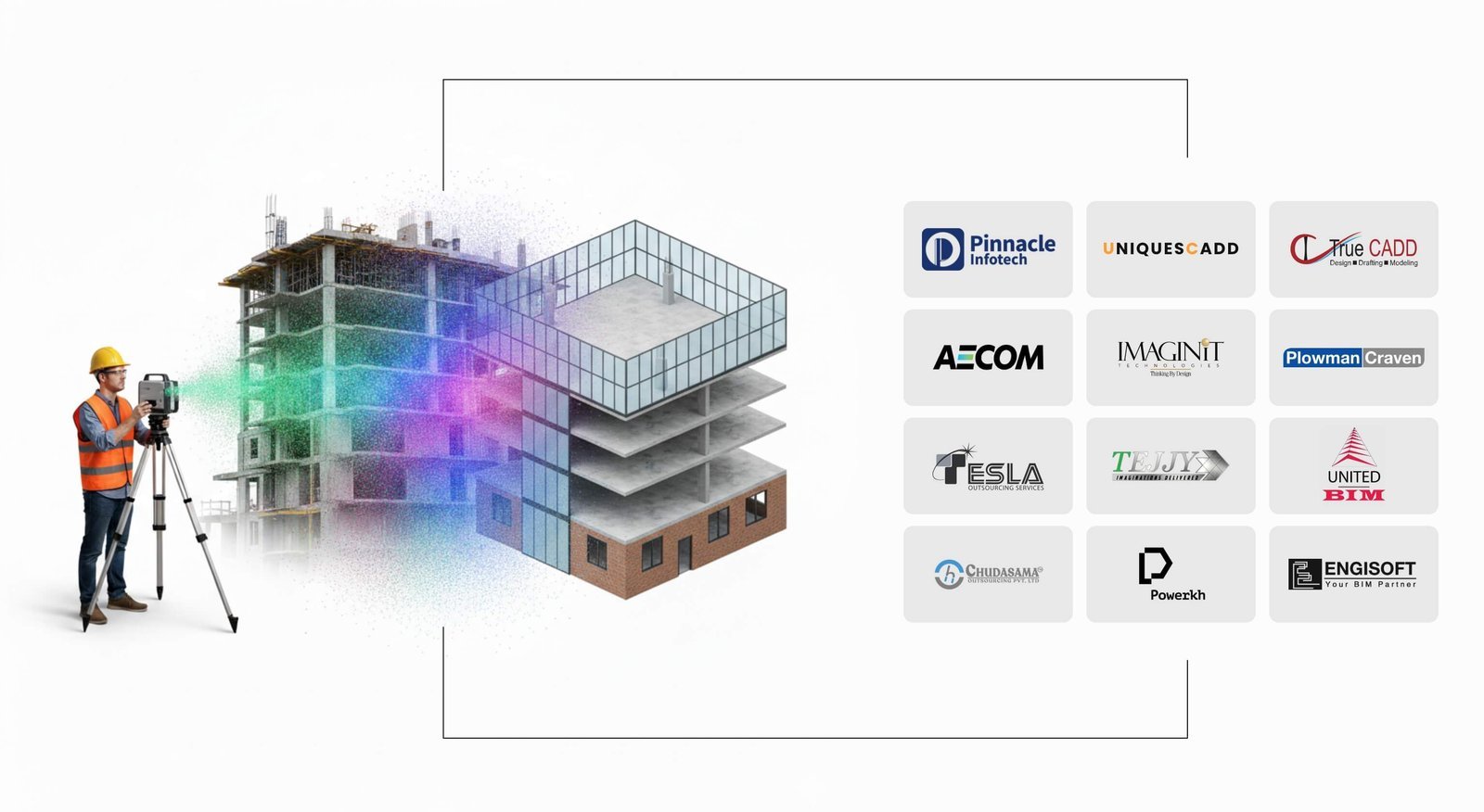
  • Pinnacle Infotech Solutions: Known for high-volume, cost-effective Scan to BIM services globally. Expertise spans architectural, structural, and MEP BIM services up to LOD 500. Strong track record in complex projects, renovations, and facility management integration.
  • UniquesCADD: A well-regarded BIM services provider with a range of services, such as MEP BIM services and CAD outsourcing service provider, delivers exceptional services for renovation projects. The firm has a team of experts, the right technology, best-in-class infrastructure, suitable pricing plans, and a renowned global clientele. Scan to BIM experts bring high-quality solutions along with consistent support through the project.
  • TrueCADD: Highly experienced in processing and managing high volumes of scanned data. Specializes in accurate point cloud to BIM conversion for complex architectural, structural, and MEP projects for renovation and retrofitting, with a strong presence in the US and UK.
  • AECOM Infrastructure: A global leader in infrastructure. While primarily a design and engineering firm, they are a massive user and integrator of BIM and Scan to BIM workflows for large, complex, and high-profile projects worldwide (airports, transit, etc.). Focus on BIM integration for digital twins and asset lifecycle management.
  • IMAGINiT Technologies: Focuses heavily on BIM technology consulting, implementation, and training. They offer high-end Scan to BIM services, often coupled with their expertise in Autodesk software (Revit, ReCap) and workflow optimization for architectural, engineering, and construction firms in North America.
  • Plowman Craven: A highly reputable UK-based company specializing in precise surveying, laser scanning, and Scan to BIM. Known for exceptional accuracy and detailed models for commercial, infrastructure, and heritage preservation projects. They are innovators in reality capture techniques.
  • Tesla Outsourcing Services: Known for converting point cloud data into detailed BIM models with very high accuracy. Strong focus on creating as-built models for renovation, refurbishment, and facility management purposes across architectural, structural, and MEP disciplines.
  • Tejjy Inc.: Offers comprehensive Scan to BIM services and is well-regarded for BIM coordination and clash detection, alongside as-built model creation. Utilizes 3D laser scanning to support renovation, as-built documentation, and facility management across various LODs.
  • United-BIM: A focused provider of Scan to BIM and related BIM/VDC services. They leverage point cloud data to create detailed 3D models for architects, engineers, and contractors, emphasizing digital transformation and streamlining construction workflows.
  • Chudasama Outsourcing: With over 15 years of experience, this outsourcing firm provides Scan-to-BIM solutions to clients across multiple countries. It offers point cloud to BIM conversion, MEP services, and 3D laser scanning and modeling.
  • Powerkh: Known for providing advanced Scan to BIM and Virtual Design & Construction (VDC) services. Strong emphasis on digital twin creation, model coordination, and clash detection from point cloud data, serving architects, engineers, and developers internationally.
  • Engisoft Engineering: A consistent name in the outsourcing market, Engisoft Engineering offers point cloud to BIM services for different categories of the AEC sector. Their services are categorized into various stages of the process, enabling smooth, efficient, and accurate workflow.

These are the best scan to BIM service providers. However, there are other players in the market, making their name and competing to create a specific benchmark. As competition rises and technological development continues to evolve, every outsourcing service provider aims to harness the power of cutting-edge technology to deliver the most desirable results. While the market is dynamic in nature, a few tech advancements in 2026 are going to impact the current process for the scan-to-BIM approach. Explore the development in the market for outsourcing service providers for point cloud to BIM.

The market is constantly developing with technologies, new approaches, and innovations. The architecture and construction industry has rapidly evolved with CAD and BIM services, eliminating the manual and traditional methods. To stay ahead in the competition and deliver accurate project results, it is evident that harnessing the power of the latest technology is essential. The following are some of the possible trends that will reshape the entire BIM scanning market.

Trends in Point Cloud to BIM

Integration of AI and Machine Learning (ML)
Enhanced visualization with AR/VR
Real-time scanning and monitoring
Development of Digital Twin technology
  • Integration of AI and Machine Learning (ML): Using AI to automate the extraction of features from point cloud data will significantly increase efficiency.
  • Real-time scanning and monitoring: The use of advanced laser scanning for continuous, real-time data collection will help monitor construction progress and reduce errors.
  • Enhanced visualization with AR/VR: Integrating Scan-to-BIM models with augmented and virtual reality will provide better visualization for clients and stakeholders, improving collaboration and understanding.
  • Development of Digital Twin technology: Scan-to-BIM is a foundational part of creating “digital twins,” which are used for facility management and performance analysis over the entire building lifecycle.

The above-mentioned key trends are reshaping the approach and promising the most accurate and advanced results with a streamlined process. These innovations will also simplify the complex strategies for renovating and enable AEC experts to deliver high-quality outcomes without any conflicts and delays. Therefore, it is essential to outsource to firms that constantly adopt new trends and technologies to achieve efficient results and enhance workflow.

Why Outsource Scan to BIM to UniquesCAD?

As briefly discussed in various scans of BIM firms, outsourcing is a crucial and beneficial result for AEC firms. In a constantly evolving market, AEC firms look for novel ways to get hands-on with accurate project outcomes. Despite having an in-house team for scanning to BIM, companies tend to outsource to top service providers due to the numerous benefits of outsourcing. UniquesCADD is one of the top outsourcing CAD and BIM service providers, offering a wide range of other services, including,

MEP BIM services, scan to BIM, shop drawings, visualisations, and more. The team at UniquesCADD aims to deliver the project on time and with high quality by leveraging the latest technology, a strategic approach, and keen attention to detail. A team of professionals ensures staying connected with the project till the end for accuracy and efficiency. Following are some of the key benefits of outsourcing with UniquesCADD;

  • High-quality project results
  • On-time project delivery
  • Dedicated resources
  • Transparent pricing
  • Accuracy and efficiency

Ending Note

AEC companies tend to outsource scanning to BIM services for efficiency and accuracy, which brings desired results. The outsourcing market has become vast, and numerous players offer scan-to-BIM services provided by a team of experts.

Advanced Revit Family Creation Techniques for Complex Design

Building information modeling is a valuable tool in the modern architecture and construction landscape. Adopting the latest technology and the increasing complexity of design are significant challenges for AEC professionals. As BIM is a crucial aspect in today’s AEC realm, it has evolved with a variety of different approaches and tools that not only simplify the challenge but also bring accurate outcomes.

Staying updated with tools and technologies is vital for architects, designers, engineers, and other professionals to cater to the needs of construction projects accurately. Among various advancements, Revit revolutionized the industry, which was developed by Autodesk. In simple terms, Revit is a BIM software that enables AEC professionals to design, simulate, and visualize construction projects.

Building information modeling has become a go-to tool for AEC professionals due to its significant benefits and visual representation of the entire model. As BIM offers a 3D data-rich model, every aspect of the building is integrated, from accurate windows to designer staircases to attractive painting on walls, along with the right lighting. The model also incorporates materials and textures that enable stakeholders to gain a deep understanding of how the project will appear. All the objects in reality in our surroundings are integrated into a model to achieve a realistic look and feel, which also simplifies the monotonous task for AEC professionals.

One of the powerful features of Revit is the capability to create families for the projects. These families played a crucial role in designing the model and served as a foundation for accuracy and efficiency. With consistent advancements and growing technology, the complexity of design in architectural projects is rapidly increasing.

Integrating Revit family services into the BIM model enables AEC professionals to enhance the quality of design and input objects that accurately reflect the real world. The integration of advanced Revit family creation into the 3D BIM model presents challenges that can be time-consuming. It is evident to adopt some quick techniques that simplify the process and save crucial time. However, let’s begin with an in-depth understanding of Revit family creation services.

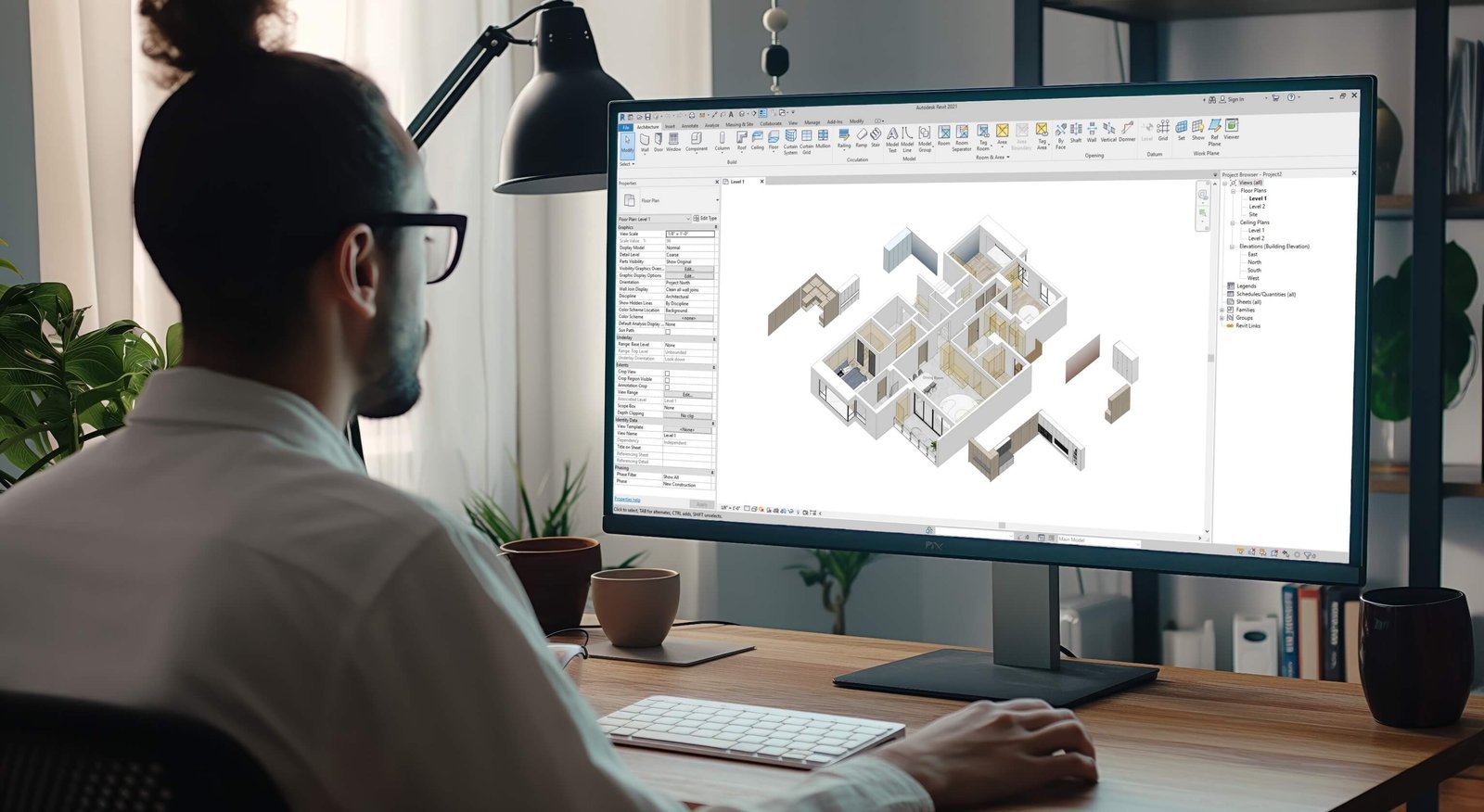
Manage Complex Designs with Advanced Revit Family Techniques

bim services

What is a Revit Family and Its Key Features

In the growing landscape of architecture and the construction industry, Revit families serve as the building blocks of models, comprising parametric components. It is a specialized service that enables architects, designers, engineers, and other professionals to develop Revit families and customize them according to the specific demands and requirements of projects.

As a matter of fact, these components are usually defined in the software, such as windows, doors, furniture, HVAC units, structural elements, and more. However, one can easily customize the components according to the defined geometry. From architectural BIM family creation to MEP families, Revit has become a valuable tool in today’s modern landscape, offering a variety of perks and being essential for a project’s success. Usually, Revit families are categorized into three segments, as follows;

  • System Families: Built-in, predefined families (walls, floors, ceilings, etc.) that cannot be modified.
  • Loadable Families: Customizable components that can be created, loaded, and reused across multiple projects in the future.
  • In-Place Families: Families that are created and modified within a project and are unique to that specific project file. These cannot be used for different projects.

As mentioned above, Revit families are specifically beneficial for large-scale and complex design projects that require custom furniture, systems, or lighting textures. Inbuilt families or system families are not customizable and cannot be used. Whereas professionals may use loadable families to store for future projects or in place families that allow both creation and modification. All this enables AEC professionals to save significant time and expedite the complex process. Not only this, but advanced Revit family creation services have various benefits, as follows;

Various Benefits of Revit Family Creation

Time saving
Consistency
Optimized performance
Improved design accuracy
Enhanced collaboration
Sustainability
  • Time saving: Custom families reduce the need for repetitive modeling tasks, allowing teams to focus on design and coordination rather than creating families from scratch.
  • Improved design accuracy: Custom families are created with precision, reducing errors that can occur from using generic or poorly constructed families.
  • Consistency: Standardized families ensure uniformity in design elements across multiple projects, streamlining collaboration and project execution.
  • Enhanced collaboration: A shared library of custom families facilitates collaboration across various disciplines, including architecture, engineering, and construction.
  • Optimized performance: Efficient families, designed with file size and performance in mind, ensure smooth model handling, even in large and complex projects.
  • Sustainability: Optimized Revit families creation allows for better material usage and more efficient energy modeling, especially in highly detailed MEP elements or design families.

There are various benefits to Revit families; however, implementing the right one allows you to reap all the perks according to project requirements. As it entails various advantages, there are different features for complex Revit family modeling, enabling professionals to maintain accuracy and efficiency, as follows;

  • Parametric components: In the parametric Revit families, users can curate data-rich, intelligent components according to their requirements and model.
  • Collaborative design: AEC professionals can enhance collaboration in the single model with the help of Revit, which leads to minimizing the scope of errors and rework.
  • Visualization and analysis: As Revit families comprise various components, they enhance visualization through 3D walkthroughs and rendering, resulting in better design understandability. Moreover, Revit also helps in the analysis of tools for performance simulation and energy analysis.

The features mentioned above are the key ones. Utilizing the power of Revit family services for architecture and construction projects brings a variety of benefits; however, complex design plans require a few tricks and techniques for seamless execution. As the AEC sector continues to rise, complexity in design is increasing, which entails several challenges and may also slow down the design process. This can consume crucial time and may lead to a delay as well. Therefore, it is evident to utilize 3D BIM Revit family techniques to simplify complexity and achieve an accurate design model. Being a powerful aspect of the AEC realm, it is vast and continues to evolve in response to technological advancements.

Complex architecture design requires keen attention to detail and accuracy in creating Revit families. In fact, MEP Revit families in complex designs are essential to ensure precision and synchronization among all disciplines. Let’s briefly understand some key techniques for advanced Revit families.

Advanced Techniques for Revit Family Creation

As briefly discussed, the creation of architectural Revit families and their importance has evolved with the rise in technology. As a BIM software, it has quickly gained popularity due to its ability to enhance project quality and contribute to efficiency and accuracy throughout the project lifecycle. With continuous development and the rise of technological approaches, the complexity of design is increasing.

This demands advanced techniques, workflows, and approaches to ensure that complex construction and architectural designs are catered to with utmost efficiency and accuracy, resulting in project success. Furthermore, common Revit family creation tips cannot provide precise solutions for complex designs, and hence, they require the implementation of advanced techniques to achieve the desired outcomes.

In fact, advanced techniques and approaches are becoming increasingly significant and crucial for AEC professionals to stay ahead in the competition and deliver accurate and exceptional project outcomes. Such techniques enable the curation of more data-rich, precise modeling, enhanced collaboration, efficient data management, and other benefits. All this results in an optimized workflow, minimized errors, sustainable design as required, safe and adhered-to standard MEP designs, and more. The following are some key techniques for Revit family services.

Techniques for Revit Family Creation

Modeling Methods
Nested Families
Parametric Revit families
Collaboration and coordination
Complex family geometry
  • Modeling Methods: Leveraging the power of advanced modeling enables AEC professionals to create specific and efficient designs for their projects. This consists of adaptive components, which are powerful tools for curating components that adapt to different conditions and parameters. Such elements or components are specifically used to create customer curtain walls, trusses, or any other aspect that requires flexibility. With adaptive components, designers and architects ensure that the components adjust seamlessly to project changes and deliver the required outcomes.
  • Parametric Revit families: These types of families are a significant part of Revit creation services, as they help create components that can be modified according to size, shape, and predefined parameters. From creating parametric families to advanced family editor techniques, it is crucial for complex building design. Creating parametric Revit components involves streamlining reference planes, dimensions, and constraints to ensure the family behaves as intended. With visibility settings and conditional statements, it creates families according to the construction project requirements.
  • Nested Families: These are part of parametric revit families that are embedded within another family, creating modularity and reusability. For complex designs, nested families enable AEC experts to create smaller, manageable components (such as door handles, mullions, or light fixtures) and subsequently group them into larger assemblies. This makes component modifications much easier, as there is only a need to update the nested family and have those updates propagate across all instances, stages, or throughout the project.
  • Collaboration and coordination: Another Revit family best practices is to utilize the best collaboration and coordination tools. In fact, it is a significant aspect of the BIM workflow that enables all AEC professionals to stay on the same page and align with the updated project progress. Worksharing and collaboration tools in Revit enable multiple experts to work on the same project simultaneously. Tools like BIM 360 help enhance collaboration by providing cloud-based project management and real-time updates.
  • Complex family geometry: Using sweeps, revolves, and lofted forms for geometrically complex designs, Revit enables AEC experts to employ various methods to create 3D shapes, including sweeps, revolves, and lofted forms. These tools also help create more organic, curved, or freeform shapes, which are essential for complex architectural elements such as sculptural facades, intricate structural components, or custom furniture, ensuring accuracy and efficiency in the model.

These are various techniques for creating advanced Revit families for complex project designs. To ensure every design fulfills the approach and achieves the desired results, Revit families help maintain accuracy and efficiency. From enhancing communication, collaboration, precision, and maintaining consistency, these techniques allow AEC professionals to manage the complexity and challenges in the design stages. As a matter of fact, the advanced Revit family brings true potential for AEC experts to manage intricate design processes that include architectural, structural, MEP, and more.

From enhancing collaboration to ensuring each aspect of a construction project is curated with precision. However, considering the rapid pace of technological developments and the vital nature of this approach, utilizing the power of Revit requires expertise, proficiency in software, knowledge, and keen attention to detail. Here, AEC firms outsource Revit family creation services to reliable service providers. Understand how outsourcing Revit family services is beneficial.

Outsourcing Revit Family Creation

The AEC industry is constantly advancing, and staying ahead of the competition is a crucial aspect for growth. Utilizing advanced technologies and approaches in architecture and construction projects, expertise, knowledge, and proficiency in software are essential to achieve the desired goals. AEC firms are typically burdened with a variety of tasks and consistently seek ways to reduce costs. Hiring an in-house team for Revit family creation can be an added expense, as it involves hiring talent, providing required infrastructure, purchasing tools and software with licenses, dedicating significant time, overseeing the team, and managing market fluctuations, among other expenses.

All this becomes an added expense for AEC firms. Here, the key solution is to outsource the Revit family to a reliable BIM company. Outsourcing service providers ensure the project is accurately catered to, aligning with the goals. In fact, outsourcing experts leverage the power of the latest technology with a well-trained team of professionals who understand the process, strategically plan, and bring about the desired outcomes. Moreover, outsourcing service companies ensure accuracy, precision, and quick project delivery along with consistent support.

UniquesCADD is a top BIM service provider with expertise in Revit family creation services by a team of experts at cost-effective plans. With the use of the latest technology and the ability to manage large and complex projects, UniquesCADD aims to deliver the project with utmost efficiency and accuracy.

In a Nutshell

Revit is the most powerful tool that quickly became valuable for AEC professionals. Utilizing the latest tools, software, and technologies, implementing tips and techniques can help to cater to complex design projects.

Top Benefits of Revit Modeling for Architectural Design Firms

The modern architecture and construction landscape demands precise efficiency, accuracy, and reliability. Today’s construction projects are infused with modern techniques, the latest technology, an exceptional approach, and expert advice. As architectural projects have become more complex and require a precise process, it is important to implement the latest technology and a comprehensive approach for desired results. Old ways, traditional methods, and previous tech cannot be helpful in architectural projects. Moreover, nowadays, the complexity of designing and integrating sustainable solutions is increasing, considering the growing environmental concerns.

Unarguably, architecture projects demand advanced processes, technology, a holistic approach, and skillful professionals for accurate outcomes. As the architecture and construction sector has witnessed an intense wave of transformation in process, design, execution, and technology, it has reshaped the old working approach into a practical and accurate architecture process. The AEC realm is introduced with building information modeling services that have completely changed the industry with numerous benefits and an enhanced construction approach.

With that comes Revit, a BIM software that is now widely adopted in the AEC realm for accuracy and efficiency in architectural projects. In the continuously evolving market, architecture firms and construction companies must adapt to the latest technology to remain competitive. The introduction of 3D BIM software like Revit significantly changed the process, approach, and outcome for AEC professionals. This has particularly taken the AEC landscape beyond the concept of 2D drawings and offered power to create exceptional architectural designs in 3D format.

Revit modeling for architects, engineers, and other professionals offers numerous benefits, including the generation of floor plans and the creation of exceptional virtual reality experiences. Revit offers an array of features and capabilities that enhance architectural designs and improve construction accuracy, all while adhering to safety standards. As a matter of fact, revit architectural services have revolutionized the process of designing and allowing AEC professionals to visualize, stimulate and execute the planned project with precision, quality, efficiency and safety standards on the construction site.

In the advancing landscape, Revit modeling continues to shape the AEC sector with more innovative, faster, and efficient construction processes, driven by technological evolution. Not only this, architectural BIM services bring a plethora of advantages for architectural firms. Let’s begin with a brief understanding of Revit modeling and further discuss its countless perks.

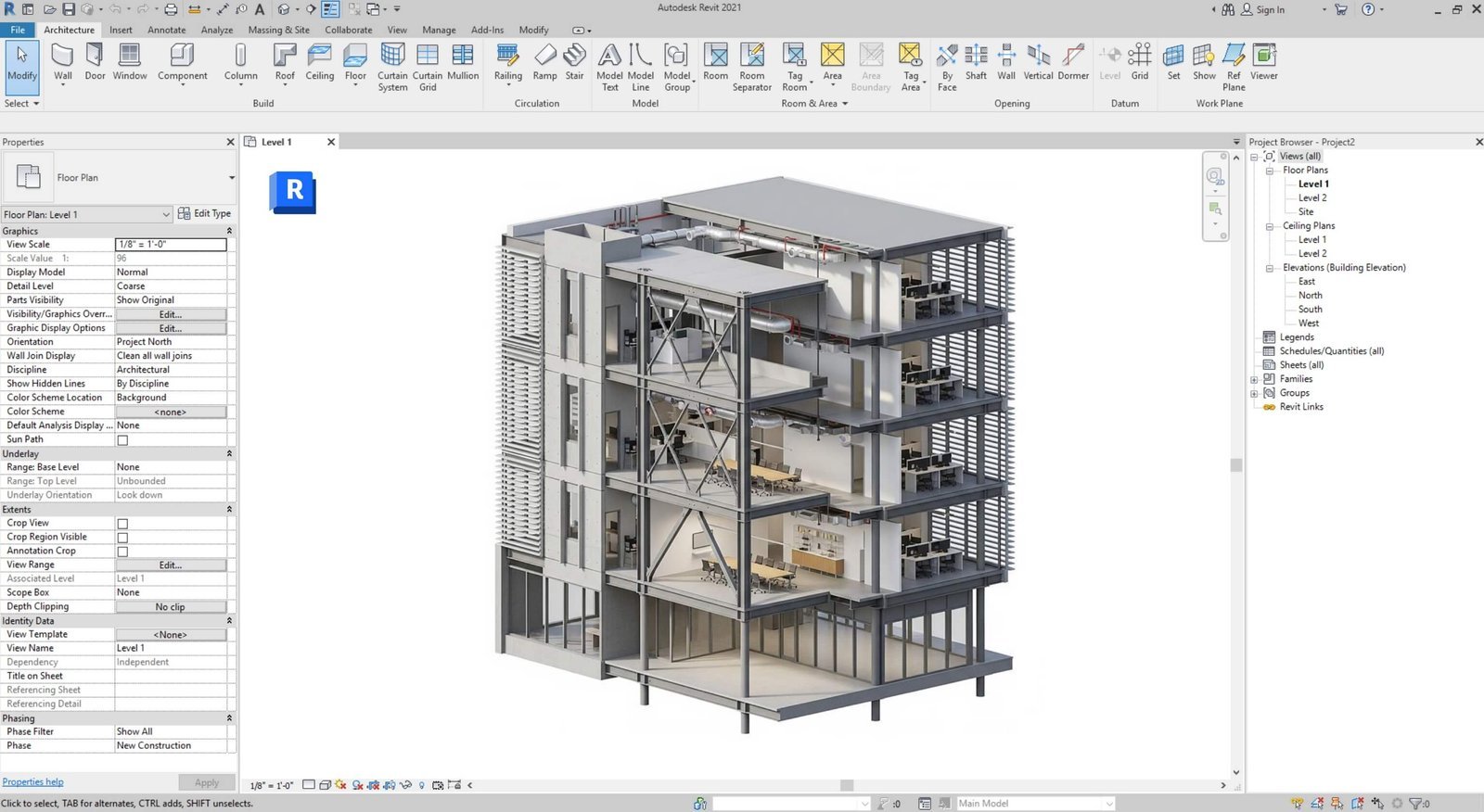
Partner with UniquesCADD for Exceptional Revit Modeling Services

bim services

Overview of Revit BIM Modeling Services

The architecture and construction sector is complex and evolving, thanks to emerging technology and innovations. BIM is one of the technologies, or per se, a concept that changed the AEC landscape. From visualizing the project to facility management, building information modeling plays a significant role in the modern AEC landscape. This has enabled architects, engineers, and other experts to enhance the accuracy of construction projects.

Moreover, BIM modeling services are now an indispensable tool in the modern construction realm that allows improved coordination, communication, better cost estimation, and informed decision-making. The 3D model of the project helps to visualize it in a precise manner. With a data-rich digital version of the project, architectural BIM services support the construction project, from the installation planning stage to facility management. However, Revit-powered BIM solutions shape the AEC sector into more accurate and reliable solutions.

Revit modeling for architects and other professionals is an advanced approach that is now widely accepted in the architecture and construction realm. With significant help of BIM technology, 3D modeling for architecture projects represents design and technical parameters for AEC experts to bring advanced, enhanced and accurate project outcomes. Using Revit enables professionals to minimize manual work processes, leading to better project results and saving crucial time and cost.

Moreover, Revit adheres to architectural drawing standards, ensuring accuracy, efficiency, and compliance with industrial codes and policies to prevent any legal issues. It helps architects and designers adhere to the codes while enabling reduced errors, seamless collaboration, enhanced creativity, and a streamlined work process. Being a significant technology or software in the AEC realm, it features multiple aspects that allow an easy 3D modeling process of the project. Let’s further discuss in detail.

Key Features of Architectural Revit Services

In the emerging and continuously evolving sector, Revit has become one of the powerful technologies that allows professionals to seek enhanced approaches for architecture projects. As a matter of fact, it offers numerous benefits that lead to the desired outcome of the architecture project. Being a significant and powerful tool in the industry, it offers robust features that enable architects, designers, engineers, and other professionals to streamline the 3D modeling for architecture projects as well as the execution. The following are some of the significant features of Revit BIM modeling.

Revit BIM Modeling Aspects

Clash detection and coordination tools
Data-rich modeling
Energy analysis
Collaborative work process
Enhanced visualization
Streamlined modifications
Parametric components and automatic updates
  • Clash detection and coordination tools: Revit, as a BIM software, has in-built clash detection tools that identify errors, clashes, or conflicts at an early stage, resulting in reduced errors, costly rework, and crucial time.
  • Parametric components and automatic updates: This feature ensures that any change in the 3D model is reflected across the model and its elements, thereby maintaining consistency in projects, drawings, and construction documentation.
  • Data-rich modeling: BIM for architectural design carries significant information that facilitates informed decision making, quick analysis, and accelerates the construction process.
  • Collaborative work process: One of the primary features of architectural Revit services is collaboration through cloud-based tools like Revit cloud worksharing. It specifically allows different AEC professionals to work on the same model in real time, along with tracking changes.
  • Enhanced visualization: Revit BIM modeling enhances visualization aspects for AEC experts in 3D format, helping them understand the design concept more clearly.
  • Energy analysis: It is a vital aspect of Revit that enables real-time energy and sustainability performance of the building design, ensuring each element supports the sustainable design factor.
  • Streamlined modifications: With simplified processes, changes in design are automatically updated in different areas of projects, which maintains coordination in different disciplines of the project.

Those mentioned above are some of the key features of Revit architectural BIM services that collectively make this an essential tool in AEC for offering high-quality, accurate, and data-rich BIM models. Furthermore, architecture firms adopt Revit modeling to ensure accuracy and compete in the competitive market. This isn’t the only reason, as there are numerous benefits of Revit for architectural firms. The following provides detailed insights into the top benefits, along with an overview of why outsourcing is a holistic approach.

Benefits of Revit Modeling for Architecture Projects

As briefly discussed, Revit BIM modeling offers robust features that lead to construction project success. Moreover, in the ever-evolving state of the sector, accuracy and efficiency are the constant paramount of a project’s success. Since its inception, Revit has been a significant part of the architecture and construction landscape. Due to 3D modeling and other intelligent capabilities, it has reshaped how projects are planned, designed, visualized, and executed. With a variety of key features, the benefits of Revit in architecture and construction projects are numerous, as follows;

Significant Advantages of Revit Modeling

Automation
Scheduling
Error detection and risk mitigation
Energy analysis
Collaboration
Parametric modeling
Cloud-based access
Rendering presentation
Construction documentation
  • Automation: This is one of the significant benefits that is quite crucial in the modern architecture realm. In a single database, all the relevant data and other important details are stored for developing an accurate Revit 3D model. It also includes the automation of changes throughout the model, which leads to saving time, effort, and resources. Automation in the 3D model results in efficient and accurate building design without over budgeting in the project.
  • Collaboration: It is another beneficial aspect of Revit modeling as it allows AEC professionals to make changes to the same model in real time, enabling other experts to be updated. This ability to support multiple user interfaces helps in saving time and enhances collaboration among different AEC professionals.
  • Scheduling: The Revit 3D model acts as a database, storing nearly all information and scheduling facilities, thereby eliminating manual workflow. This also helps in instantly updating any changes that are made in the Revit model, keeping all the professionals informed to make further decisions. It also streamlines the process of reworking that is one of the time consuming processes.
  • Parametric modeling: Revit, as a BIM software, incorporates parametric modeling through Revit Families built into the software. These families are accessed through libraries, and some can be designed from scratch by architects according to project requirements. This significantly enhances the project and visualization aspects through the parametric modeling technique.
  • Error detection and risk mitigation: Risk, errors, and conflicts are common in the construction project, considering various stages and the involvement of different components. However, with the right approach to implementing architectural Revit services, several errors and conflicts can be resolved at the initial stage. This saves time in rework and reduces project costs, while also eliminating potential factors that could lead to mishappenings on the construction site.
  • Cloud-based access: Architecture projects involve many professionals, some working remotely or in a hybrid culture. With a significant rise in flexible working environments, Revit for architectural firms leverages its power of cloud-based collaboration that offers accessibility of information and models to AEC professionals. Architects, designers, or other experts can save or make amendments that are well communicated with professionals. This amplifies the use and ease in working on large and complex construction projects.
  • Energy analysis: With the growing environmental concerns, sustainability and energy-efficient design have become a significant part of the AEC industry. Clients demand energy-efficient design and sustainable factors, saving the environment. Here, architectural BIM services play a crucial role in offering energy-efficient design, accurate analysis, and sustainable planning that allows AEC experts to optimize energy efficiency.
  • Rendering presentation: Building only a 3D model isn’t the end goal; the model must entail different textures, elements, and materials. Incorporating these components for a realistic version is a time-consuming and complex process. Revit 3D modeling for architecture projects provides tools for rendering and 3D visualizations that are seamless, realistic, and time-saving for professionals.
  • Construction documentation: 3D Revit models, as said, are enriched with detailed information and data about the project. While accuracy and efficiency are key to success, construction documentation plays a pivotal role too, which is helpful during the construction and facility management. As Revit modeling services enable AEC experts to coordinate and perform clash detection at an early stage, it helps in curating high-quality and accurate construction documentation. Error-free, accurate, well-detailed, and coordinated construction documents are helpful in gaining legal permissions and certificates, resulting in seamless project delivery.

The benefits of Revit in architecture firms are numerous, ranging from enhanced coordination to streamlined project delivery. Moreover, it is the most beneficial aspect to define parameters of accuracy and efficiency in the project while allowing stakeholders to visualize the infrastructure in 3D format before it’s built.

It enhances efficiency, accuracy, coordination, visualization, and more in the construction project. Implementing Revit modeling demands a strategic approach, the right technology, skills, expertise, knowledge, and more. Revit architecture outsourcing is a comprehensive solution for architectural firms that lack resources and infrastructure, seeking ways to reduce costs.

Outsourcing Architectural Revit Services

Implementing architectural Revit modeling requires significant talent, the latest technology, and the best infrastructure to achieve accurate outcomes. As construction projects are complex in nature and entail various stages, the right implementation of Revit modeling services is evident. With the rise of technology and emerging innovations, the AEC realm has witnessed a wave of transformation that has allowed AEC professionals to enhance the quality of projects and bring precise outcomes.

Since architectural firms often lack the necessary resources and the latest technology or software, implementing the right approach can be quite difficult. Therefore, outsourcing Revit modeling is a significant solution that not only brings precision in architecture projects but enables firms to have hands-on, evident, efficient, and accurate 3D models that bring high-quality construction outcomes. UniquesCADD is a leading BIM company in India, providing advanced Revit modeling services delivered by a team of experts and utilizing cutting-edge technology to achieve efficient and rapid results. The following are some of the benefits of outsourcing with UniquesCADD;

  • Timely project delivery
  • Access to experts
  • Latest technology use
  • Cost effective

Conclusion

Architectural BIM services are paramount for the success of construction projects in today’s modern era. With strategic and precise implementation, architectural firms can deliver accurate projects within the designated timeline.

BIM-Ready Revit Families for Building Product Manufacturers

The construction industry has already witnessed significant changes that have improved the approach. Growing technology and innovation have fostered various benefits, comprehensive methodologies, precision, and quality in projects. As every construction project is complex and uniquely created based on strategic planning, holistic design, accuracy in functionality, and other factors, technology and innovation play a key role.

In the ever-evolving industry, architects, engineers, and other professionals have adopted new approaches that lead to precision, enhanced quality, and efficiency. Among a variety of emerging trends in the realm, building information modeling is a key approach and groundbreaking technology for the AEC industry, considering how it has brought a drastic transformation to the architecture and construction industry.

With significant benefits and ease in the construction process, BIM-related technologies also contributed to enhancing the process, offering simplified solutions, accurate outcomes, improved communication, and more. Amidst the massive alterations in the architecture and construction industry, Revit family creation services have become a pioneering approach in AEC projects. The introduction of Revit families has drastically changed the working methodologies for architects, engineers, and contractors in building design. Moreover, Revit family creation helps product manufacturers as well, offering a variety of benefits to ensure precise curation of components.

A construction project isn’t only about having a strong framework but also ensuring the functional components of the infrastructure are precise, efficient, and safe for occupants. These components include MEP components, walls, doors, stairs, furniture, and many more. A construction project BIM model helps in visualization, and with these elements, stakeholders can easily understand the scope and design.

On the other hand, the Revit family is equally significant for manufacturers in many aspects. As BIM has evolved exponentially in the AEC market, it continues to develop in response to market demand, also impacting Revit family creation. Let’s delve deeply into Revit family creation services and explore how they are beneficial for manufacturers.

Enhance Product Manufacturing with Precise Revit Family Creation

bim services

Understanding Revit Family Creation in Depth

Constructing an entire building is a complex, tedious, and time-consuming process. It involves various stages that contribute to the project’s success. However, each stage demands precision, efficiency, keen attention to detail, accuracy, and more. The role of BIM modeling services is amplified here, considering the long list of benefits. Since every infrastructure entails several components that are manufactured or fabricated, revit family creation plays a vital role. It fosters design accuracy, saves time and cost, reduces the scope of errors, and brings various benefits. Simply put, Revit is a BIM software by Autodesk that brings various components or elements for professionals to use in their project models.

A Revit family is a significant part of Revit, and various families serve as building blocks in digitally curated projects. As a matter of fact, it represents the infrastructure parts like doors, fittings, furniture, windows, MEP components, and other various elements in 3D format. AEC professionals have access to the Revit library, which can be curated according to specific requirements, modified to suit existing families, and utilized for other projects. Typically, Revit families are categorized under three variations: the following are

  • System families
  • Loadable families
  • In place families

With three different categories, Revit family creation also brings various benefits to construction projects. From improved design quality to fostering collaboration, creating reusable parametric Revit families allows professionals to streamline the process and reduce the chances of errors. The following are key advantages of Revit family creation,

  • Accurate representation
  • Consistency and standardization
  • Parametric modeling
  • Less modeling time
  • Fosters collaboration and communication
  • Customization, flexibility, and reusability

The list of benefits can be extensive; however, these key perks are particularly relevant for AEC professionals, highlighting the significance of modern architecture. However, Revit family creation services are beneficial not only in the manufacturing process but also in the AEC industry. Discover how Revit serves as a vital resource for manufacturers.

Revit Family Creation for Manufacturers

In the fields of architecture and construction, precision and efficiency are key to project success. Accuracy is evident throughout all stages, including the infrastructure’s components. Components are manufactured or fabricated according to the project’s requirements; hence, Revit family creation in the BIM model ensures the provision of the right geometry for elements. Manufacturing is a vital part of construction, defined as the production of tangible elements to be installed in a building as a whole or as part of it.

Being a significant process, it is equally tedious, as a minor mistake could lead to high costs, delayed projects, inaccuracy, and more. Therefore, the manufacturing industry also reaps numerous benefits of BIM object creation to assure quality and precision. In the ever-evolving market, manufacturers utilize the power of building information technology for conceptual design, analysis, costing, and more.

Manufacturers utilize Revit primarily for pipes, ducts, lighting fixtures, and other components that require precise fabrication, including those with specified parameters such as materials, type, color, properties, and dimensions. In fact, BIM-ready Revit families also elevate the sales of manufacturers’ products. As the 3D model enables product manufacturers to create specified products, Revit family integration ensures precision and quality, depending on the project.

As construction processes require a high-quality and accurate approach, manufacturers use Revit family creation specifically for HVAC components due to their complexity and level of precision. Manufacturers adopting Revit families can visually represent their products, components, or equipment to architects and designers, enabling the right selection of products and seamless integration into the construction process. Not only this, but Revit families for manufacturers are crucial in various ways, the following are;

Importance of Revit Family for Manufacturers

Accurate representation
Enhanced design coordination
Streamlined workflow
Better visualization
Component customization
Increased visibility and accessibility
Precise material and cost estimation
  • Accurate representation: By adopting Revit families, it offers high-end, intricate, and precise 3D models with component geometry, dimensions, materials, and other required details.
  • Better visualization: Before the final production of components or products begins, manufacturers, designers, architects, and other involved professionals can visualize the integration of the product in the design with greater clarity and understanding.
  • Enhanced design coordination: Coordination is a vital aspect of the construction process. Implementing the Revit family for manufacturers helps ensure that the design product or component is integrated accurately into the design, with no conflicts during construction.
  • Component customization: Revit families enable manufacturers to create multiple configurations and customize them within the same Revit family. It ensures the choice of the most reliable and suitable variation is chosen depending on the project requirements.
  • Streamlined workflow: As technology has accelerated the process, manufacturers adopting parametric Revit families can quickly and easily create products without consuming significant time, thereby reducing errors and saving costs.
  • Increased visibility and accessibility: Designers, architects, and other professionals can easily access the products made in Revit families. This accelerates the process, maintains communication, and saves time in finding the right component for the project.
  • Precise material and cost estimation: Revit families contain specified information about materials, performance characteristics, quantities, texture, and more, which is used to identify the estimated cost and material schedules.

These are the key aspects where Revit family creation for manufacturers plays a vital role. As a matter of fact, this strategic technology also offers various benefits apart from ensuring the project and design efficiency. As briefly discussed, the importance of Revit families for manufacturers cannot be overlooked, as BIM objects represent all the technical characteristics of products.

This also helps ensure the final production of components is seamless and by the model, thereby maintaining design efficiency, accuracy, and reliability. The following are some of the benefits that highlight the importance of BIM-ready Revit families for product manufacturers.

BIM ready Revit Families Role

3D Product Model for Website
Design flexibility
Product Specification in Detail
Custom Designing
  • 3D Product Model for Website: This is one of the significant reasons manufacturers implement BIM Revit families. The ability to create 3D models for websites, architects, designers, and other professionals allows them to view, download, and integrate digital content into their projects. This also enhances the selling power of manufacturers while AEC professionals can accurately execute construction projects.
  • Product Specification in Detail: As discussed, creating a Revit family entails intricate detailing and data, including materials, textures, properties, and more. High-quality 3D models are detailed, making it easy for architects and designers to examine and understand the product closely. Moreover, it also provides clients with a clear understanding of the component before final production begins.
  • Design flexibility: Manufacturers can adapt customized facilities, allowing for quick modifications to the product. Design flexibility in Revit family creation enhances project quality, streamlines the process, and reduces time spent on creating accurate components tailored to the project.
  • Custom Designing: Typically beneficial for furniture manufacturers, Revit families allow users to create unique custom objects digitally. Once approved by the client, the manufacturer can quickly create the tangible version of the component, ensuring accuracy, efficiency, reduced material wastage, and more.

BIM is the most effective tool for representing the technical aspects of architectural and MEP components, allowing stakeholders to understand them in a 3D digital format easily. Additionally, this strategic tool helps streamline the complex process without conflicts or changes to the building design. In the modern architecture and construction realm, it is essential to maintain cost, accuracy, and efficiency throughout the project.

Due to its various stages and complex nature, Revit family creation is a challenging approach that demands acute skills, precision, expertise, knowledge of the software, and more. Typically, manufacturing industries lack the expertise to implement the Revit family creation approach; however, due to its rising importance and numerous benefits, it is crucial.

Outsource Revit family creation is one of the comprehensive approaches for AEC professionals as well as manufacturers. Moreover, it allows hands-on, precise, and required models without investing high capital in the firm. Discovering how to partner with a BIM company in India can be helpful for manufacturers.

Outsourcing Revit Family Creation: Key Insights

As discussed, Revit family creation has become a strategic tool in the architecture and construction industry. Due to the 3D representation of components, it becomes easier for architects and designers to integrate into the BIM model. As a matter of fact, with a plethora of benefits in the AEC sector, it is also comprehensive for product manufacturers. With the increasing importance and need for precision in projects, the manufacturing industry is increasingly outsourcing Revit family creation services to a renowned BIM company.

In the modern and continuously evolving AEC industry, outsourcing is the most beneficial and holistic solution. Outsourcing to a renowned BIM company offers various benefits, including precision and quality, without requiring a high capital investment. Outsourcing service providers have a team of professionals who are well-versed in the process, technology, and complex nature of the tool. Meanwhile, Revit is a complex software that continually upgrades with emerging innovations. Therefore, it demands expertise and an adaptive nature to ensure accurate outcomes. Outsourcing comes with various perks, such as;

  • Technology and experts’ access
  • Cost-effective solutions
  • Accuracy and efficiency
  • Quick turnaround
  • Tailored solutions

The list of advantages can go long. UniquesCADD is a renowned and top BIM company in India, offering Revit family creation with precision. With a specialized team of experts and best-in-class infrastructure, UniquesCADD ensures that it offers the desired outcomes for AEC professionals as well as manufacturers.

Final Remark

Revit Family Creation Services is a strategic tool that has the potential to enhance complex construction projects into high-quality and accurate results. This plays a crucial role for product manufacturers, allowing them to create specified and efficient products for the projects.

Scan to BIM in Infrastructure Projects: Roads, Bridges, and Tunnels

Accuracy, efficiency, and safety are three pillars of a successful construction project. In the modern world, the construction and architecture industry is continuously transforming with the evolution of technology. Innovation and technology play a significant role in offering accurate, efficient, and safe solutions in the AEC sector. Architects, engineers, designers, and other professionals look for significant ways to enhance the construction process, streamline operations, and ensure building safety. Today, modern architecture and construction are reshaped by pivotal technology known as BIM services, which have brought enhanced, accurate, and more efficient construction results from start to finish.

Building information modeling introductions has altered how architects, designers, engineers, and other professionals work together. Due to the complex and lengthy construction process, BIM offers a holistic approach with several benefits, making it easier to navigate the intricate process. AEC is a vast sector comprising a variety of constructions, ranging from small to large scale, from residential to commercial, and including infrastructure development and more.

Regardless of construction type, accuracy and efficiency are prominent for a project’s success. Speaking of which, infrastructure development projects are far more critical and complicated, requiring keen precision. Roads, highways, bridges, tunnels, and other infrastructure projects fall under complex projects that are often too intricate in nature. Considering the use, purpose, and idea of such development directly impacts the country’s growth. Better development and more growth are the reasons why 3D BIM modeling services play a crucial role in infrastructure development projects. BIM focuses on managing complex design and on-site work, ensuring accuracy and safety for long-term use.

The safety and longevity of roads, bridges, tunnels, and more are essential for public well-being and also facilitate stronger national development. Since the development of these bridges, roads, or tunnels is a one-time investment, it is evident that maintaining this infrastructure is crucial to avoid any risks or mishappenings. Hence, to sustain efficiency and longevity in the infrastructure project, point cloud modeling services are beneficial. Since traditional methods or manual surveys of infrastructure projects are time-consuming, prone to errors, and less efficient, scanning for BIM becomes a profitable approach for early detection of structural weaknesses or areas of risk. Let’s explore in detail about scan to BIM for infrastructure.

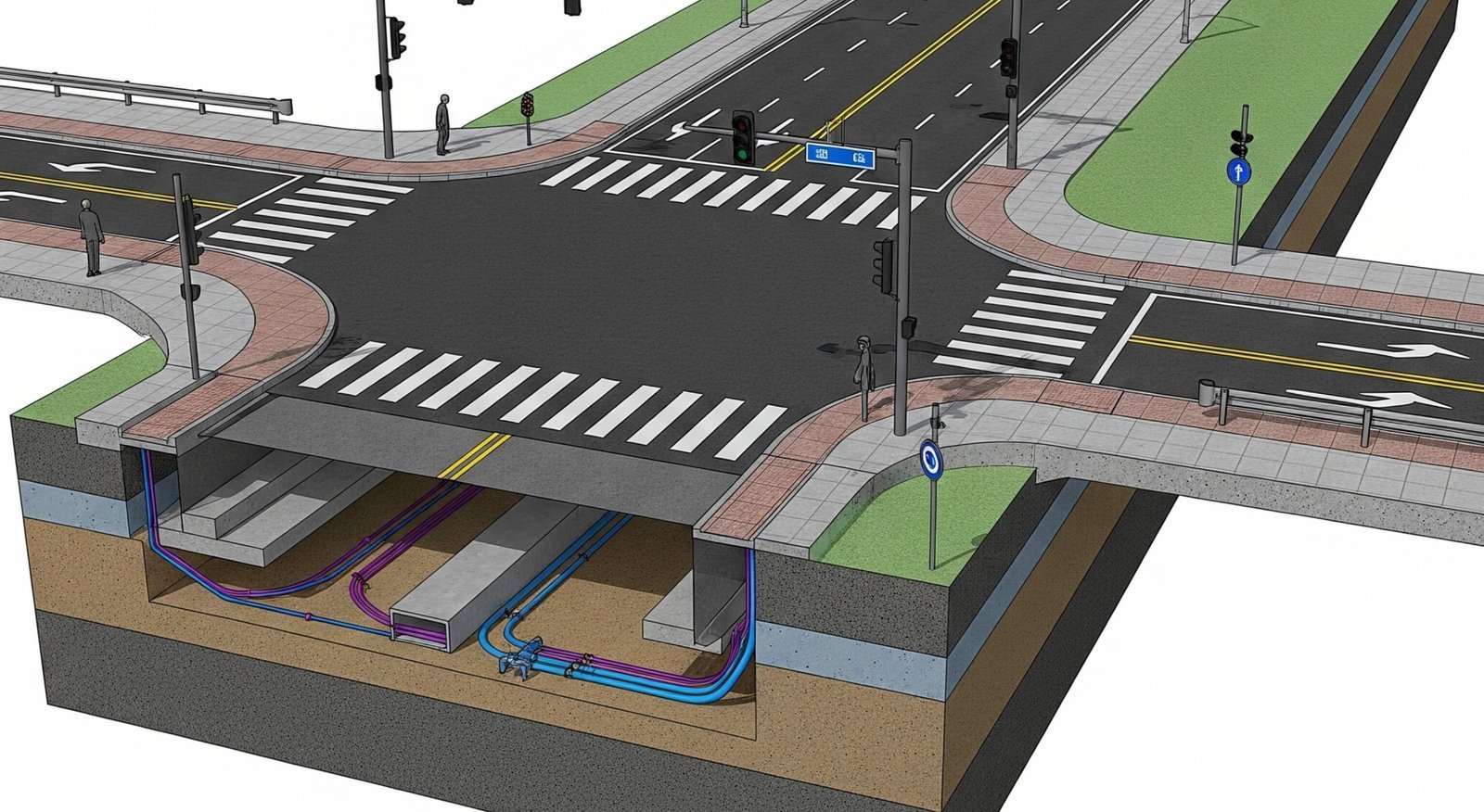
Manage Large Scale Infrastructure Project with Scan to BIM Modeling

bim services

What is Point Cloud to BIM Service?

In the complex sector of architecture and construction, Scan to BIM services stand out as they allow AEC professionals to intricately work on existing structures. After constructing the building, it is vital to maintain the facility, keep it functioning, and ensure the safety standard. Here, laser scanning technology plays a vital aspect that is further integrated into the 3D BIM model. With advanced technology, AEC professionals can easily manage existing infrastructure, refine facility management, and ensure safety.

Scan to 3D BIM modeling services have become popular in the architecture and construction industry due to a variety of aspects and benefits from it. The primary goal is to capture, interpret, and translate the data into a BIM model, allowing professionals to identify areas of fault or potential renovations. Following are some of the key benefits of point cloud modeling services.

Perks of Scan to BIM in AEC

Enhanced accuracy
Cost savings
Seamless workflow
Improved collaboration
Clash detection and conflict resolution
  • Enhanced accuracy: With the help of laser scanning technology, Scan to BIM ensures improved accuracy and efficiency in complex design structures, as it collects data points from inaccessible areas and provides insights for repairs. This helps to escalate the project and maintain accuracy during the project.
  • Seamless workflow: Integrated with the 3D BIM model, AEC professionals can identify issues, conflicts, and more in the existing structure and make the required changes. The BIM workflow fosters a faster and streamlined process, as every AEC expert works on the same model, resulting in enhanced accuracy.
  • Cost savings: Another significant benefit of point clouds in BIM is the cost efficiency during the project. Managing, repairing, or renovating an existing infrastructure requires resources, materials, technology, and more. With point cloud to BIM, professionals allocate and manage resources according to the digital information.
  • Improved collaboration: Point cloud to BIM services enhances collaboration by providing a shared space for architects, engineers, and other collaborators to fulfill their respective roles. This enhances collaboration, reduces errors, and streamlines work approaches for complex infrastructure design.
  • Clash detection and conflict resolution: Scan to BIM facilitates early clash detection and brings definitive solutions by proposing required changes in the existing structure plane. Clash detection reduces rework, minimizes delays, and enhances project efficiency.

These are a few benefits of point cloud modeling services. As the list can be extensive, this laser scanning technology is also crucial for infrastructure projects, including roads, bridges, and tunnels. Point cloud to BIM for roads and other mega projects helps to identify key areas of structural weakness, ensuring public well-being and avoiding any mishaps. Explore in detail how scanning to BIM is helpful for infrastructure projects.

Scan to BIM for Infrastructure Project: A Crucial Role

Infrastructure construction and maintenance are tough and critical tasks. The world’s infrastructure is the backbone of the economy, as it is said, “better infrastructure, advanced economy.” As we look around, buildings’ designs have become more intricate, marvelous, and unique. But ever thought about how roads, bridges, tunnels are constructed?

Today, in the fast-paced world, roads are interconnected, widened, and smooth. Bridges seamlessly improve traffic flow, enhance better connectivity for travel, and more. To ensure these infrastructures are safe for public use, it is essential to adhere to regulatory standards. Here Point cloud to BIM software is a game changer. The detailed model, through the laser scanning process, supports structural analysis, compliance with regulatory standards, identifying crucial flaws, streamlining projects, and more.

As important as the service is, point cloud to BIM offers accurate as-built documentation and enables proper asset management. Typically, the process involves 3D laser scanning of the structure and integrating the collected point data into a 3D BIM model. As a matter of fact, bridge BIM modeling, tunnel, and road offer accurate digital representation that enables AEC professionals to minimize errors and enhance accuracy along with safety during the process. Explore various applications of the scan-to-BIM services for different infrastructure projects.

  • Roads: Capturing existing road conditions, including surface irregularities, pavement distress, and signage, to plan for maintenance, overlays, or widening projects, scan-to-BIM services bring enhanced solutions and maintain efficiency. Moreover, the model is also used to predict future road intersections and interchanges, significantly reducing potential conflicts. This promotes traffic flow, enhances safety, and improves time management for travel. Scan-to-BIM models are also used for utility mapping, which enables the identification of existing underground utilities, such as cables, pipes, and more. It helps to reduce clashes during the process. Not only this but point cloud to BIM for roads can also be integrated with GIS (Geographic Information Systems) for infrastructure management.
  • Bridges: Scan to BIM monitors structural health, involving the detection of minor deformations, cracks, potential collisions, areas for improvement, and necessary repairs. This helps to safeguard public well-being as well as means of communication for travel. As a matter of fact, bridge BIM modeling helps to maintain and enhance the lifespan of the bridge. Additionally, with a built model, experts can implement repair plans or structural enhancement without compromising the position of existing components. Since bridges are mega-infrastructure projects that demand utmost safety, verifying cleaners for new projects is evident when compiling safety regulations. Scan to BIM also helps in restoring and documenting intricate historical bridge details while maintaining accuracy and precision.
  • Tunnels: Constructing and maintaining tunnels is a tedious and critical job. Here, Tunnel BIM modeling brings efficient solutions for the identified defects, cracks, and water entrance, which is vital for maintaining safety and precision. The Scan to BIM model is also optimally utilized for structural analysis and monitoring tunnel stability to identify areas for improvement. Here, the role of MEP BIM services also comes into play, considering proper lighting, ventilation, and water management in the confined space of the tunnel. 3D BIM modeling services provide a digital representation of physical and functional characteristics, while point cloud services ensure the safety and stability of tunnels. As a matter of fact, constructing a tunnel also means having utilities mapping for geographic information to avoid any risks, errors, or challenges during the significant process.

This is how roads, bridges, and tunnels are maintained, repaired, and constructed. Point cloud to BIM services provide holistic solutions for infrastructure projects, as precision, attention to detail, and efficiency are key to success. As a matter of fact, scan to BIM for infrastructure also brings several benefits, including;

Key Benefits of Scan to BIM for Infrastructure Projects

Lifecycle management
Improved communication and collaboration
Minimize errors and reworks
Early clash detection
Enhanced efficiency and precision
Cost-effective

These benefits highlight the crucial importance of scan-to-BIM technology and how mega-scale infrastructures are designed and maintained. The AEC industry leverages the power of the latest technology and innovation to consistently deliver improved results. This fosters the integration of new trends, technologies, and innovations that yield better results. Explore the future horizon of point cloud modeling services.

Future Outlook of Scan to BIM

The architecture and construction realm has come a long way, witnessing a transformation wave in methodologies and approaches. As traditional work methods have become increasingly ineffective in the face of the growing impact of modern solutions, technologies, and emerging innovations, the AEC industry is now revolutionized with upscaling performance. Accuracy, efficiency, and precision in the architecture project are vital, and BIM services were the significant role players. As evolution is continuous and advancements continue to reshape the industry, the architecture and construction industry has witnessed new technologies for greater precision and ease in the process.

Scan to BIM is a popular approach for renovation, infrastructure, and other projects, but the future of this approach looks promising with an advanced method that leads to greater efficiency, accuracy, and seamless integration with other tools. Following are some of the emerging trends and technologies that can further revolutionize the approach.

  • Digital twins
  • Better scanning devices
  • Cloud-based collaboration
  • AI and ML
  • AR and VR

These emerging technologies transform point cloud data into 3D BIM modeling services. As it is not just a technology but a holistic asset for the AEC industry, the integration of the innovation mentioned above will bring enhanced results, well-managed facilities, and proactive solutions to challenges. Due to its growing significance, promising future outlook, and numerous benefits, it is advisable to outsource scanning to BIM for infrastructure projects. Considering the scale and complexity of projects, outsourcing experts can offer reliable solutions, allowing AEC firms to focus on their core responsibilities. Understand in detail why outsourcing point cloud to BIM solutions are valid.

Insights to Outsourcing Point Cloud to BIM Solutions

AEC firms are always seeking effective ways to enhance current processes and streamline operations. With mega-scale infrastructure projects in hand, such as roads, bridges, tunnels, or dams, it is crucial to focus on the core task. From strategic planning to smooth execution, many challenges and hindrances arise, which is why AEC firms outsource scan to BIM services from a reliable service provider to have hands on the most precise model while streamlining the daily operations.

Additionally, instead of hiring an in-house team, outsourcing BIM experts is a more beneficial and cost-effective approach for AEC firms. As scan to BIM is a critical role player in the AEC projects, strategic planning and approach are equally important. Outsourcing services providers have a team of professionals and significant technologies that ensure precision in the project while strictly adhering to regulations. Following are some of the major benefits of outsourcing point cloud BIM services;

  • Cost-effective
  • Strategic approach
  • Access to the latest technology and experts
  • Timely project delivery
  • Accurate and efficient outcomes
  • Tailored solutions

These benefits highlight the importance of outsourcing scan to BIM services to professionals. It demands keen attention to detail, the use of accurate software tools, and a strategic approach to implementation. UniquesCADD is a top scan to BIM company with significant experience and a team of professionals. With the use of the latest tools, we ensure that we offer the most precise and accurate results for our architecture projects.

Concluding Remarks

Point cloud modeling services are crucial in the AEC realm, offering accurate and efficient results for renovation projects or mega infrastructure projects to ensure precision, safety, and facility management.

Role of BIM Consultants in CAD to BIM Transition

The landscape of architecture and the construction sector has witnessed significant changes in the aspects of process, technologies, work approach, demand, and much more. It is safe to say that the industry has adopted the latest advancements to meet the dynamic demands and thrive in the global economy. The profound transformation has led the industry to alter how AEC professionals plan, design, and execute the entire construction project. The architecture and construction sector has come a long way, from spending crucial hours working on a blueprint to curating accurate 2D layout plans. With the advancement in technology and alterations in processes, AEC professionals have adopted the revolutionary evolution that enhances the outcomes and ensures the accuracy in the approach. To begin with, the architecture and construction industry witnessed a transformative development with computer-aided design.

This key development has shifted AEC professionals from paper to computer screen, resulting in higher proficiency, accuracy, and efficiency in the project. Streamlining the design process with the help of CAD services has allowed architects and engineers to simplify the approach, enhance the quality, and ensure its accuracy, resulting in less rework. Transportation from paper sketches to computer screens required the use of technology and software called AutoCAD, which allows experts to develop two-dimensional representations of the structures.

Taking the front seat in the 70s, it was gradually adopted by the AEC experts. Although it had various benefits, it came with its limitations, which became a challenge as the industry took another leap of development. Since CAD quickly became a necessary approach for all AEC professionals, building information modeling services was another transformative revolution. Popularly known as BIM, it soon became a go-to tool for every architect, engineer, and other professional.

Considering the capabilities of the BIM adoption process and its ability to go beyond, it has transformed the architecture and construction realm. The AEC sector witnessed vital changes from paper to computer screen to 3D BIM modeling that have enhanced visualizations, overcome CAD limitations, offered data-rich insights, improved communication, and precision in the overall construction process. Only BIM services have offered a plethora of perks and approaches that have resolved every complex design challenge. As a matter of fact, with this, CAD to BIM services became the most adopted approach among architects, engineers, and other professionals. Consistent advancement and rise in technology have made conversion from CAD to BIM possible for professionals to explore the curve of modern architecture and its design. This transition is catered by a vital role player known as BIM consultants. Today, in the ever-evolving horizon of architecture, BIM consulting services help in seeking and adopting the right approach for CAD to BIM conversion. Let’s discuss in detail how BIM consultants help to embrace CAD for BIM migration services.

Enhance CAD to BIM Services with UniquesCADD Experts

bim services

In-Depth Insights for CAD Conversion to BIM

Precision and efficiency are paramount to success in the realm of architecture and construction. As CAD services were the first advancements, shifting professionals from paper sketches to computer screens has altered the reality of the sector. Moving ahead with technological advancements, building information modeling services reshaped the working approach for architects, engineers, and other experts, offering a comprehensive 3D view and rich data insights. As CAD is a design approach that enhances the entire planning of the project, BIM is a digital representation of the same in 3D view, along with all the insights of the design.

Moreover, the concept of BIM serves as a management tool from the initial stage to project lifecycle management. With the continuous development and challenges in modern architecture projects, CAD to BIM modeling services have become an essential approach to collaborate and enhance communication for accurate project execution. Adoption of BIM technology offered a variety of advantages and also helped AEC professionals to overcome limitations of CAD services, such as;

  • Limited collaboration
  • Lack of insights and visualization
  • Cannot cater to complex projects
  • Less project management

The above-mentioned limitations of CAD were slowly and gradually becoming an unresolved challenge. Therefore, the introduction of BIM 3D modeling not only enhanced but also offered other advantages. The introduction of revolutionary technology pushed AEC professionals to implement CAD to BIM services accurately. Transforming a 2D CAD file into a well-represented 3D model allows architects to improve the level of accuracy, efficiency, visualization, and collaboration.

In the modern architecture and construction landscape, 2D CAD drawings cannot offer in-depth insights and visualization. CAD conversion to BIM offers a comprehensive solution, as the 3D BIM model is rich in data and offers a centralized platform for AEC experts to stay updated with changes and communicate accordingly. The following are a few benefits of the CAD to BIM adoption process.

CAD to BIM Advantages

Enhanced communication and collaboration
Fewer errors and reworks
Facilitate improved design
Accurate visualization
Cost and time savings
Streamlined workflow

The transformation from CAD technology to BIM services offers a variety of advantages. In the advancing landscape of AEC, CAD to BIM workflow integration in small to large-scale projects has become a prominent approach, considering the capabilities of 3D modeling. However, the transition from CAD to BIM isn’t only about shifting from AutoCAD to Revit. The transformation requires careful planning, the right tools, a strategic process, accurate guidance, the latest approach, and more. As AEC firms understand the shift from 2D drawing to 3D modeling, accuracy in the process is vital to avoid any pitfalls. Therefore, AEC firms partner with BIM consulting services providers.

BIM consultants play a crucial role in guiding a novel path for accurate outcomes in this crucial transformation. As said, it isn’t about switching from one software to another, but demands precision in adopting the approach. BIM consultants help transition from CAD to a 3D BIM model without any room for errors. Let’s discover what BIM consulting services are and how they play a major role in the CAD to BIM shift.

Understanding BIM Consulting Services

The architecture and construction industry is on a continuous verge of evolving and advancing with technology and demand. It is evident to adopt the latest technology to cater to the latest modern construction projects. CAD technology altered the traditional approach; on the other hand, BIM technology reshaped the entire sector with unparalleled precision and other benefits. In the modern era, CAD to BIM conversion has become mandatory to achieve the desired outcomes with precision and high quality. Since the conversion demands for skills, experts, guidance, and more, BIM consultants play a major role. As a matter of fact, BIM consulting services help AEC firms and experts to plan, manage, and improve the utility of Revit modeling. The experts work alongside the team and resolve the complex challenges in the process from CAD to BIM. Moreover, the process of conversion also requires a BIM implementation strategy to achieve specific goals and meet project demands. As a matter of fact, AEC firms who are unaware of the transition process require external support from BIM services providers who are experts in bridging the gap between traditional methods and digital collaboration. This support enhances the overall project efficiency and resolves any challenges in implementing BIM modeling services.

A BIM consultant is an expert with expertise in implementing, managing, and optimizing the BIM approach. The consultant also ensures the streamlined process of BIM implementation, an accurate 3D digital model, each segment’s entitlement to information, and seamless collaboration between all the AEC professionals. Additionally, hiring BIM consulting services experts enables construction firms to reduce the scope or errors while shifting from CAD to BIM. This significantly results in improved project outcomes.

As modern construction demands the latest approach, BIM consulting experts align the design intent with modern demands of architecture, such as sustainability, energy efficiency, and strict adherence to industry guidelines and policies. Furthermore, there are some common responsibilities that BIM consultants are responsible for, the following are;

  • Coordinating project models
  • Managing data and documentation
  • Collaboration and implementation strategies
  • Ensuring BIM compliance, policies, and standardization (Country according)
  • Model auditing and quality control
  • 4D and 5D BIM integration
  • Automation and parametric design implementation

These are a few of the responsibilities of BIM consulting experts, ensuring smooth implementation, productive design processes, enhanced outcomes, and overall optimized results. With the responsibilities mentioned above, BIM consultants ensure the accurate transition from CAD to BIM. As the building information modeling services go beyond just offering digital solutions, it enhances the overall outcomes and maintenance of the building.

The crucial shift from 2D CAD drawings to 3D BIM models demands a seamless process that the BIM consultant looks after. Since the initial stage of BIM implementation, AEC firms tend to partner with the right BIM consulting company to assure the accurate conversion and precision in the BIM model. From coordinating the project model to ensuring the BIM model strictly adheres to the industry standard and policies. The following are some of the key benefits of implementing BIM consulting services.

Advantages of BIM Consulting Services

Enhanced communication and collaboration
Cost and time savings
Early clash detection and solutions
Seamless design process
Better project management
Improved accuracy and project efficiency
Precise quantity take-offs
Risk mitigation
Sustainable design intent
Improved project visualization

With a plethora of benefits, BIM consulting experts streamline the process. The expert also adds value in the CAD conversion to BIM. Let’s explore how building information modeling consultation supports the transition.

BIM Consulting Supports CAD to BIM Transition

As deeply discussed about CAD to BIM modeling services and consulting services, it is evident how BIM experts help in the smooth transition from CAD to 3D BIM. Since BIM consultants are crucial role players from the beginning of the projects, they also adequately contribute to the seamless shift from CAD file to 3D BIM model. By offering significant expertise and curating accurate strategies for seamlessly transitioning 2D CAD files into BIM workflow, the expert typically helps to understand BIM standards, ensures the shift is smooth and accurate, customizes it according to the project, and more. Here’s how BIM consulting services support CAD transition to BIM model.

  • Assessment and Planning: BIM consultants explore and analyze the current CAD workflow, understanding the project requirements for the best BIM implementation. Once the project assessment and current CAD workflow are analyzed, the consultant develops a basic BIM implementation strategy and technology selection that aligns with the design, purpose, and project goals. This ensures a smooth transition and reduces the scope of errors.
  • Streamlined workflow and collaboration: The BIM consultants also ensure that the CAD model is converted into 3D BIM, ensuring data accuracy and compatibility. Moreover, they curate a strategic process to ensure that the information is shared with every professional involved in the project. This helps improve communication and collaboration while keeping a keen eye out for early clash detection. BIM experts proactively resolve conflicts, saving extensive cost, time, and resource effort.
  • Entailing BIM benefits: Improving the design process and enhancing visualization for stakeholders is one of the key goals of every BIM consultant. It allows clarity and better understanding of complex designs. With the help of enhanced visualisations, AEC professionals and stakeholders can make an informed decision for the further construction process. BIM experts ensure to harness every benefit of BIM and optimize the overall project for precision and efficient on-ground construction work.
  • Performance monitoring: This is a crucial step for BIM experts to ensure a seamless CAD to BIM transition. Once the CAD file is converted into a 3D model, it is evident to monitor the model’s behaviour and performance for further development of the construction project. Analyzing performance allows experts to quickly identify areas of improvement and optimize the BIM workflow integration. As a matter of fact, consultants can provide training and constant support to the AEC firm to harness the power of building information modeling technology.

These are a few key points where BIM consulting services are implemented and utilized to optimize the BIM model from the CAD file. As a matter of fact, consulting services for transitions or BIM services, AEC firms look for outsourcing BIM companies that can offer the right expertise and enhance the overall quality of the project at cost-effective pricing plans. UniquesCADD is a renowned BIM company offering precise BIM consultancy by a team of experts. Hiring BIM consultants significantly reduces project cost, saves time, and improves collaboration.

Last Thoughts

CAD to BIM services are a holistic approach in today’s AEC landscape. Due to their growing importance and benefits, it is essential to partner with BIM consulting experts who can ensure accuracy and efficiency during the transition of CAD to BIM while monitoring the BIM model performance to avoid costly errors.

Understanding the Pivotal Difference Between BIM vs. CAD

Building information modeling is a valuable and go-to approach in today’s architecture and construction industry. Understanding and catering to modern architecture projects, AEC professionals have achieved a new level of excellence in the sector with BIM technology. In today’s digital era, BIM has become a significant tool for architects, designers, engineers, and other professionals. Before BIM transformed the industry with multiple perks and capabilities, CAD was a popular tool that enabled architects and designers to shift from drafting tables to computer screens. This eliminated the traditional practices of hand-drawn sketches, long working hours, and possible errors and rework.

With computer-aided design technology, AEC experts could enhance the complex process and ensure accuracy without errors. This technology in the architecture and construction industry transformed with a working approach, bringing a new face to the sector. Before BIM, CAD drafting services were quickly adopted due to beneficial reasons and accurate process outcomes. Not only this, but the implementation of CAD was a complete game changer for professionals to design with precision, enhance quality, improve communication, and much more.

As the economy’s technology showed no signs of stopping, it reshaped the reality of the construction sector by introducing building information modeling services. Since CAD drafting had given its primary contribution, it had few limitations in the modern architecture era. During the early 80s, CAD gave a new path in the AEC while advancing technology transformed the approach with BIM architectural services. Precision, efficiency, and reliability have always been paramount for any project’s success. For professionals to ensure the project’s success, CAD implementation was evident in transforming the traditional working methodologies. In the current scenario of AEC today, CAD and 3D BIM services have emerged as important technologies for quality, precision, and efficiency.

Each technology plays a different role, which is why it is crucial to understand when to use CAD and BIM services in AEC projects. Since CAD has significantly changed from drafting tables to computer screens, BIM offers a holistic approach to project construction, design, execution, and management. Due to the different capabilities of each technology, BIM and CAD comparison has always been a topic of debate for renowned AEC professionals. Let’s discuss each revolutionary technology in detail and its differences for a better understanding and appropriate use in the projects.

Upscale Project Quality with BIM and CAD Expertise by UniquesCADD

bim services

Brief Insights on Computer-Aided Design Technology

As discussed, professionals manually completed all the necessary tasks of the project, from drawing to curating blueprints. With CAD’s introduction in the industry, AEC professionals quickly adopted the power of the automated approach. This technology has replaced the manual or traditional hand-drafting working process with computer-based solutions. Implementation of this technology has resulted in the utmost precision, efficiency, and detailed representation of the infrastructure in 2D and 3D views. At its best, CAD drafters and professionals can create accurate and detailed 2D or 3D representations of the objects as well as the building. AEC firms in today’s modern era partner with CAD service provider for accurate and efficient results.
Apart from offering detailed representations of the infrastructure, CAD is also useful in drafting different project disciplines, such as mechanical CAD drafting services, electrical CAD drafting, and more. These detailed drawings allow MEP experts to maintain accuracy and understand the design intent and 2D and 3D capabilities. As a matter of fact, for years, CAD services have been a backbone of the architecture industry, drafting complex floor elevations with accuracy and efficiency. Following are some of the key benefits of CAD in AEC projects;

Key Benefits of CAD in AEC Projects

Cost reduction
Collaboration and communication
Faster design iterations
Enhanced visualization
Increased efficiency and productivity
Reduced rework

These are the generic benefits of computer-aided design technology; however, its key features make it the most adopted technology in the AEC realm. As these benefits enhance the construction projects, key features of CAD technology enable professionals to improve the overall design process. The following are the key features of CAD;

  • Geometry-centric precision: CAD software offers comprehensive tools for curating accurate lines, shapes, and curves. This allows designers and architects to have hands-on detailed drawings for construction projects.
  • 2D and 3D design capabilities: One of the significant features of CAD drafting is the creation of 2D and 3D designs, which empowers AEC professionals to improve communication, visualization, and collaboration, resulting in overall design precision.
  • Isolated object focus: CAD software and files often represent isolated objects, components, parts, and more. Specific layouts or other technical drawings are also represented to enhance focus and minimize errors.

CAD’s efficiency and accuracy enable professionals to work closely on the intended design and bring efficient results in the overall process. As technology has advanced over time, it is evident that designers, architects, engineers, and other professionals can adopt new technologies and stay ahead of the market. Additionally, CAD drafting services have transformed the face of the architecture sector, although the inception of BIM architectural services has hit the sector with revolutionary waves. Let’s understand BIM in detail.

3D BIM Services in AEC Projects

BIM in the architecture and construction sector isn’t an unfamiliar concept. In modern architecture, staying ahead of the market curve, adapting innovation, and implementing the latest construction practices enhance project results. As discussed, CAD has pushed architects and designers to use computer screens, and 3D BIM services play a significant role in the industry now. Typically, it refers to the representation of different functional and physical characteristics. BIM offers a data-rich intelligent 3D model that entails data of every component, leading to enhanced communication, collaboration, improved design, and more. In the modern architecture landscape, BIM isn’t just a tool or a mere technology but has emerged as a revolutionary approach that supports collaboration and communication among various professionals involved in the projects.

Tools like Revit and Archicad have become popular BIM software that transform the design, planning, and execution process. The data-rich 3D model encompasses geometry, spatial interrelationships, geographic information systems, and material quantities. With the help of accurate BIM services, AEC experts can track progress, manage project costs, ensure accuracy in the design, minimize the scope of errors on the ground, and more. Above all, BIM modeling services bring a plethora of benefits, such as;

Benefits BIM Modeling Services

Data-driven model
Improved visualization
Reduced errors
Informed decision making
Enhanced communication and collaboration
Centralized platform

With a plethora of advantages, building information modeling has become a go-to tool for architects, engineers, and other professionals. The collaborative power of BIM allows experts to streamline the design and planning process while ensuring accurate on-site construction management. With a data-rich model, BIM enhances the visualizations of the project before even it’s built, resulting in fewer errors, reworks, and cost savings. However, in the modern architecture horizon, it is crucial to understand when to use BIM and CAD services in the project.

Besides BIM being a key role player in the sector, CAD technology has wholly vanished. Many AEC firms and individual experts use CAD files and transform them into BIM models for effective and accurate results. This process typically involves AutoCAD to BIM services, which have become quite common in the market. CAD technical drawings are precisely converted into 3D BIM models, enabling professionals to have hands-on data rich building models. As a matter of fact, BIM is increasingly becoming valuable as technology improves.

Difference Between BIM and CAD

In the landscape of architecture and construction, adopting the latest technology brings enhanced results and streamlines the complex process. As discussed, CAD was a significant part of the construction process that reshaped the entire industry. With building information modeling, AEC professionals enhanced and seamlessly worked on complex projects with precision and efficiency. However, this doesn’t mean CAD technology isn’t in use. With BIM, CAD plays a crucial role as mechanical CAD drafting services, electrical, and plumbing. There is often an overlap between BIM and CAD in the aspects of functionality.

Even today, AEC firms sometimes have CAD files that are transformed into data-rich 3D models for accurate visualization and reducing errors. With the accurate implementation of AutoCAD to BIM services, technical drawings files in CAD software are converted to BIM model. As each of the technologies varies from each other and plays a crucial role in the architecture and construction realm, it is evident to understand the fine line between BIM vs. CAD. The following is the difference between CAD technology and BIM technology in various aspects.

Dimensionally

  • BIM: It offers a holistic and comprehensive 3D view of buildings with functional characteristics and other sets of data.
  • CAD: CAD offers a 2D view of the project, technical drawings, and a 3D view of essential elements that enhance visualization.

Data Insights

  • BIM: 3D BIM modeling services offer rich data of every building component and element while also integrating seamless data storage for construction documentation and facility management.
  • CAD: It entails limited data, which becomes one of the limitations for complex and large-scale projects.

Collaboration

  • BIM: allows multiple AEC professionals and stakeholders to work on the same model with real-time updates due to centralized environment capability.
  • CAD: For technical drawings in CAD, generally, individual experts can create and edit without any involvement of a third party. This leads to inconsistencies and rework, specifically in large-scale commercial projects.

Workflow

  • BIM: Building information modeling services maintain the entire project lifecycle, from conceptual design to facility maintenance.
  • CAD: Typically, it is used to create construction documents, blueprints, technical information, and more.

Project updates

  • BIM: This data-rich intelligent model automatically updates changes across the entire model. For example, a change in window size in the hall will be altered throughout the model, saving time and effort.
  • CAD: Changes in the CAD model require a manual process throughout the CAD file.

Analysis and simulation

  • BIM: 3D modeling services include simulations for early clash detection, sustainable design, energy analysis, and more. They allow experts to make informed decisions.
  • CAD: The CAD technical file limits analysis and simulation tools, which can be challenging for larger construction projects.

Project budget

  • BIM: The data-rich intelligent model offers insights into cost estimation and comprehensive project tracking progress in 4D and 5D BIM levels.
  • CAD: Due to limited data, CAD offers limited cost related information.

Facility Management

  • BIM: The BIM model provides accurate facility management and maintenance activities with a data-rich model, dimensions, and detailed insights into components and elements.
  • CAD: This is one of the limitations of CAD as it does not provide any facility maintenance insights.

This is the core BIM and CAD comparison, making 3D BIM modeling technology powerful. As a matter of fact, the use of CAD continues for detailed, technical, and mechanical drawings as blueprints. This shift from AutoCAD to BIM services has quickly gained attention due to the plethora of perks and exponential capabilities of building information modeling. As significant as the technologies are, it is advised to outsource BIM services to renowned BIM experts. UniquesCADD is an award-winning outsourcing BIM company with extensive years of experience and a talented team.

Ending Notes

The distinct roles of BIM and CAD are vital in the construction landscape and for the successful execution of projects. However, understanding the difference between BIM and CAD differs on a variety of bases, so it is essential to implement each technology per the project’s requirements.

How Custom Revit Families Improve Coordination in Large-Scale BIM Projects

The architecture and construction industry is continuously evolving and advancing with technology and innovation. Today, the AEC sector has a new face of reality, working approach, and operation workflow, allowing professionals to enhance results. Advancing technology has given a new curve to the architecture industry, enabling streamlined processes with accuracy and efficiency. From traditional practices to modern working culture, technology has given a new shape to the sector. Thanks to the introduction of BIM services, AEC professionals can maintain accuracy and efficiency, reduce the scope of errors, and achieve the desired project goals. Building information modeling has revolutionized how architects, engineers, and other professionals execute construction.

Moreover, it has transformed the working approach and enhanced the efficiency of architecture project outcomes. With the integration of BIM modeling services, complex infrastructure projects are simplified and catered to achieve the project goals efficiently. As BIM represents the functional and physical characteristics of the project in 3D view with detailed insights, it helps AEC professionals minimize errors. With a plethora of capabilities and benefits, at the heart of BIM modelling services lies the concept of custom families in the architecture concept. The idea of custom families in the Revit software brings multiple scopes of benefits, allowing AEC professionals to create, modify, and manage the building components as per the project requirements.

As a matter of fact, the integration of custom Revit families enhances the design process and overall project management. From small-scale to large-scale projects, BIM has become a valuable tool for architects and engineers, while Revit family creation adds excellence to the project and offers a curve of modernization throughout the entire process. For large-scale BIM projects, countless disciplines, components, and seamless coordination are paramount to project success. BIM integrated with Revit family creation services is a strategic implementation that proves to be a powerful approach for the success of large-scale BIM projects. Let’s understand the custom Revit family creation service and how it catalyzes project success.

Elevate BIM Projects with Custom Revit Family Creation by Our Experts

bim services

Understanding Custom Revit Families in BIM Architecture

As discussed how building information modeling has altered the working approach of architects, engineers, and designers. From the enhanced design process to having data-rich insights into the infrastructure, BIM’s potential brings a plethora of accurate results. BIM modeling services in the AEC realm act as an indispensable technology; however, it comes with the associated concept of Revit creation that contributes to the construction projects’ overall performance, efficiency, and accuracy. Typically, it involves designing and creating parametric components of the building that can be used in the project.

These components, also known as families, include doors, windows, MEP systems, and other furniture for the project. These families contain parameters, data, and geometric measurements that define the behavior while adapting to various design requirements. As a crucial approach in today’s modern architecture and construction realm, Revit families can also be customized as per the project requirements.

Custom families in BIM architecture are defined as tailored families or components to meet the specific requirements of the projects. These components are not standard, pre-defined, or available in the software. Custom Revit families are designed to meet the requirements of the project while ensuring every component in the model serves its purpose accurately. Moreover, in the Revit BIM architecture, custom families for the project bring enhanced accuracy while meeting the tailored demands of the client.

Other than that, the sheer significance of the parametric revit families in large-scale BIM projects cannot be overstated, as they offer precision and efficiency compared to standard families. Customizing families, architects, and engineers can bring accuracy and efficient design solutions. Additionally, communication and collaboration among the project team members are crucial for success, which is why Revit custom families concepts are significant here.

  • Enhanced accuracy and details
  • Standardized parameters
  • Shared parameter integration
  • Classification and categorization
  • Reduced chances of errors
  • Streamlined collaboration and communication
  • Clear visual communication
  • Enhanced clash detection
  • Optimized project workflows and efficiency
  • Prefabrication and offsite manufacturing
  • Lifecycle project management

These are the advantages of customer Revit for architecture projects. By creating custom components for the project, architects and engineers ensure the element in the model is tailored as per the project’s requirements and enhances the design’s accuracy. This leads to a seamless and streamlined project workflow, bringing desired solutions. However, the significant process requires careful planning and execution to achieve the desired results. Let’s explore some of the best practices that can help create customized solutions for Revit family creation services.

Best Practices for Custom Revit Families in Large-Scale Projects

Large-scale BIM projects require significant detail, attention, accuracy, and efficiency in the process. A minor clash or error can lead to a substantial loss of time, budget, and effort. As a matter of fact, large-scale projects require careful planning and designing for precision. Here, the role of Revit families creation comes into focus as it allows the BIM model to be integrated with customized components and elements that enhance the project quality while ensuring to meet the project requirements. BIM coordination, careful planning, and executing the design are vital for large-scale project precision. Here are some of the best practices for family creation in Revit.

Best Practices for Family Creation in Revit

Establishment of clear standards
A skilled team of professionals
Robust quality processes
Collaboration and communication
Develop a comprehensive family library
Optimum utilization of family templates
Test and Trial
Leverage BIM management tools
  • Establishment of clear standards: Determining a BIM standard according to the project integrated with Revit family guidelines, parameters, and naming conventions can help map out the process for defined execution. Hence, having clear standards for the project is vital before implementing a custom Revit family.
  • Develop a comprehensive family library: Before proceeding, it is essential to identify specific components that require customization based on the complexity of the project, coordination, and details.
  • A skilled team of professionals: Another significant aspect of the BIM Revit family process is having trained professionals who are well-versed in technology, updated with trends, understand the project’s complexity, and create accurate custom Revit families per the requirements.
  • Optimum utilization of family templates: While ensuring the use of custom Revit components, it is essential to develop and utilize standard family templates that bring consistency, efficiency, and accuracy to the family creation process.
  • Robust quality processes: Customizing the Revit family isn’t the end goal. Before optimum use of the BIM model, developing an intense quality check process is vital to ensure the family’s standard is error-free for accurate large-scale projects.
  • Test and Trial: As crucial as the quality check processes, test and trial allow professionals to ensure the component behaves according to the parameters and disciplines. Before using the custom family element in the project, it is crucial to thoroughly test and validate it to ensure function, check for errors to avoid problems and ensure smoother project execution.
  • Collaboration and communication: Open communication among different AEC professionals during the family creation processes leads to efficient and precise results, as every AEC expert is informed about the project requirements.
  • Leverage BIM management tools: Another significant aspect to remember while creating custom family elements is utilizing BIM management platforms for precise organization and management and effectively sharing family libraries with different AEC experts.

These are the major aspects and practices to keep in mind while creating custom Revit families creation services. As a matter of fact, it is crucial to ensure that the custom families are fully parametric, which refers to components that can be easily modified on the basis of properties and dimensions according to various projects. As a matter of fact, parametric families save crucial time as experts can re-use the element in the project and modify it according to requirements without creating new families from scratch.

These practices allow AEC professionals to achieve accurate and efficient project outcomes while adhering to the customized Revit components. As technology advances over time, trends and new innovations alter the reality of the process. With upcoming technology, Revit family creation services will witness a wave of trends.

Future of Revit for Architecture

The latest trends and technologies will heavily influence Revit’s family creation services. The upcoming advancement will lead to better accuracy, enhanced workflow, optimized results, and improvement in the overall design process. Following are some expected trends Revit families for accurate BIM construction project management.

Future Scope for Revit Family in AEC

Parametric reusability
Digital twins
Customizable components
Automated family creation
Data rich families
Adaptable design
AI-driven design optimization

These trends can alter the current scenario of the Revit family and make it more challenging for AEC professionals to enhance project results. One comprehensive approach is to outsource Revit family creation services to a renowned firm to streamline the crucial process and improve the 3D BIM model. Explore how outsourcing can help manage efficient outcomes.

Outsourcing Revit Family Creation

UniquesCADD is a renowned BIM company with extensive experience creating Revit families. Outsourcing crucial services allows AEC firms to have hands-on, efficient results that enhance the quality and value of the project. Outsourcing by experts brings proficient, accurate, and desirable solutions to projects. Outsourcing experts are well-versed in the process, understand the project’s complexity, and ensure the use of cutting-edge technology for the best outcomes. UniquesCADD brings holistic solutions for AEC firms for Revit family creation. Following are some of the benefits;

  • Cost-effective solutions
  • Tailored services
  • Timely project delivery
  • Enhanced accuracy and efficiency
  • Expertise knowledge

Final Call

Managing large-scale BIM projects demands attention to detail, efficiency in each process, and precision for quality results. Therefore, a team of professionals is required to outsource Revit family creation services for precision and efficiency.